

ANR project
Alkali Luminescent Lanthanide-Free Polyoxometalate Salts for Water Sensing
Dates:
January 01, 2025 – December 31, 2028
Project coordinator:
Rémi DESSAPT (MIOPS team)
Partner laboratories :
- Separative Sciences and Methods Laboratory (SMS) – University of Rouen
- Polymers, Bioplymers, Surfaces Laboratory (PBS) – University of Rouen
IMN staff involved:
Olivier HERNANDEZ, Florent BOUCHER, Nicolas STEPHANT, Nicolas GAUTIER
Lanthanide-free alkaline salts of luminescent polyoxometallates for water detection
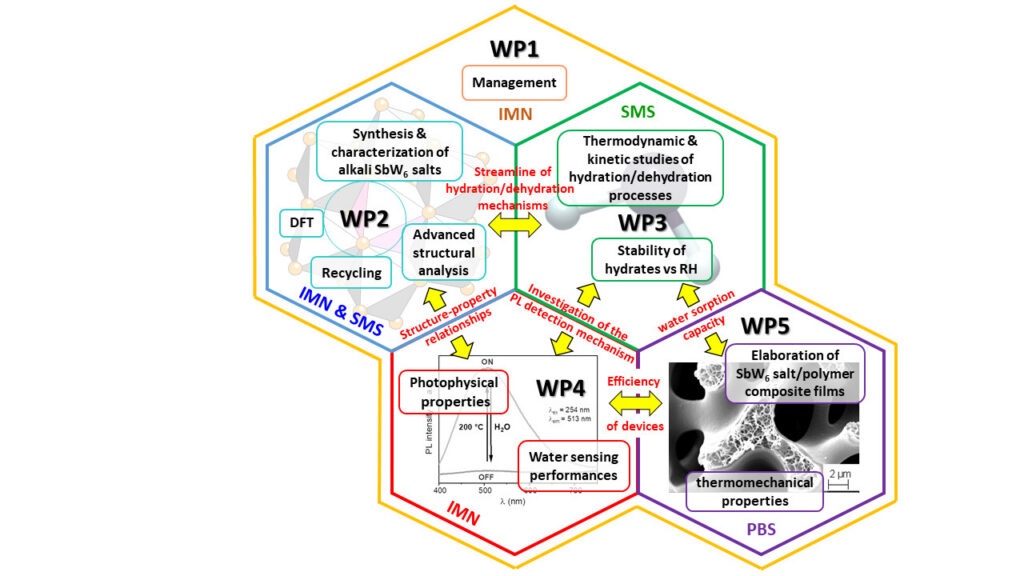
Detecting and quantifying water in liquids and gases is essential for many industrial applications. Photoluminescent detectors are increasingly being studied for their high sensitivity and in situ analysis capability. But the design of stable, reusable and recyclable detectors remains to be developed. The ALPS-Water project involves three partners: IMN, SMS and PBS. They propose to investigate the potential of new photoluminescent anhydrous alkali salts based on the lanthanide-free polyoxometallate [SbW6O24]7- (SbW6), to detect water in air and in organic solvents. These materials are produced using environmentally-friendly, low-energy synthesis processes, and are recyclable. In the presence of water, they rapidly rehydrate, extinguishing their luminescence due to the formation of hydrogen bonds between SbW6 entities and water molecules. Anhydrous phases are regenerated by moderate heating, and their hydration/dehydration processes are reproducible. The Na7[SbW6O24] material is capable of sensing moisture in air with a limit of detection (LOD) of 2.2%, and of detecting water in acetonitrile. Further investigations are needed to rationalize the complex reactivity of these salts with water, due to the existence of intermediate hydrates. Project partners will mobilize complementary cultures, skills and resources to enrich this class of materials. They will study the relationships between anhydrous and hydrated phases and optimize their detection performance. The integration of SbW6 salts in polymer matrices will also be studied, to improve the use of detection devices.