

ANR project
Radiation chemistry as a powerful tool for controlling the properties of nanometric materials
Dates:
October 2020 – May 2024
Project coordinator:
Nanosciences and Innovation for Materials, Biomedicine and Energy (NIMBE Gif-sur-Yvette)
Partner laboratories :
- IMN
- Institute of Physical Chemistry (ICP Orsay)
- Condensed Matter Chemistry (LCMCP Paris)
IMN staff involved:
Philippe POIZOT, Patricia ABELLAN, Patricia BERTONCINI, Nicolas DUPRE, Eric GAUTRON, Bernard HUMBERT, Philippe MOREAU, Patrick SOUDAN
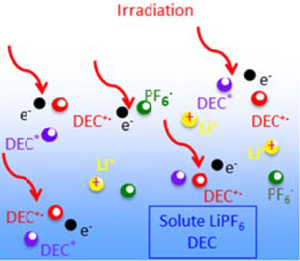
Nanometric materials are now present in many fields. In parallel with the improvement or appearance of new properties due to their nanometric size, comes the high sensitivity of surfaces highly subject to potentially problematic modifications. Aging phenomena, for example, can have dramatic consequences. Radiolysis (i.e. the chemical reactivity induced by the interaction between ionizing radiation and matter) is highly effective for rapidly creating and studying ageing species. In addition, transmission electron microscopy (TEM) can be used as an irradiation tool to visualize the generation of degradation products in situ with high spatial resolution. The aim of the ACETONE project is i) to implement and use TEM as an irradiation tool enabling in situ visualization of nanomaterial evolution under irradiation; ii) and to study under aging the modifications of nanomaterial interfaces due to the surrounding environment by different radiolysis techniques (pulsed, steady state…). We intend to save time by using radiolysis as a technique for accelerating aging, a technique which also enables us to propose detailed reaction mechanisms. This understanding of aging phenomena will in turn help to propose materials with safer and improved properties, which have potentially important industrial applications. Indeed, understanding reaction mechanisms will enable us to propose solutions in an attempt to reduce the impact of degradation phenomena. To demonstrate the validity of this approach for nanomaterials in general, we have selected examples from two areas of high societal impact: health and energy.