

ANR project
Development of a membrane-cell for in situ NAP-XPS characterization
Dates:
October 2022 – March 2027
Project coordinator:
Luis CARDENAS, Institut de Recherches sur la Catalyse et l’Environnement de Lyon (IRCELYON)
Partner laboratories :
- IMN
- Laboratory of Fluid Mechanics and Acoustics (LMFA) [Ecole Centrale de LYON].
- CRYOSCAN (from Institut Jean Lamour)
IMN staff involved:
Marie-Paule BESLAND, Valérie BRIEN, Agnès GRANIER, Pierre-Yves JOUAN, Mireille RICHARD-PLOUET, Clément MAHEU
Development of a membrane cell for in situ characterization of NAP-XPS
IMN plans to develop nanostructured TiOxNy thin films with a redox potential close to the visible range. The Institute has chosen to implement band engineering via atomic substitutions on the anionic and/or cationic networks by Plasma Enhanced Chemical Vapor Deposition (PECVD) or magnetron sputtering (MS), a technique for depositing metallic (conductive) or ceramic (insulating) thin films using plasma, in order to provide the IRCELyon partner with “model” materials.
Heterogeneous photocatalysis involves chemical processes that provide access to abundant, renewable solar energy. Much research effort has been devoted to the conversion of small molecules such as H2O, CO2 and N2 into fuels or chemicals. Unfortunately, there are significant gaps in our understanding of the mechanisms at work in the active sites of catalysts. To remedy this, XPS (X-ray Photoelectron Spectroscopy) in ultra-high vacuum (UHV) is widely used to study the active phase in catalysis. The development of Near Atmospheric Pressure (NAP) XPS should bridge the gap between the kinetic performance of catalysts and molecular reactions under in situ conditions.
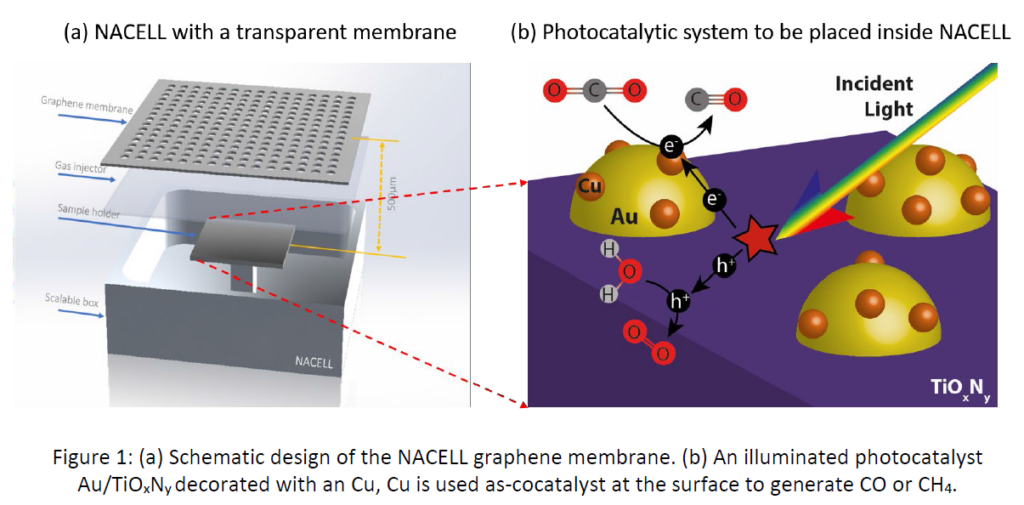
In this project, the consortium proposes to develop a 2D membrane cell device (figure 1a) that will enable XPS operando studies on thin films with photocatalytic and plasmonic properties based on titanium oxynitride (TiOxNy). These films will be made of elements abundant on earth, and will be combined with gold (Au) or copper (Cu) nanoparticles (NPs) to enable photocatalytic reduction of CO2 in the gas phase. To achieve this objective, a dedicated cell will be designed and built, and experimental protocols for routine characterization of photocatalytic materials will also be developed.