

ANR project
Evaluation of ANIONic rocking-chair ORGanic batteries for power
Dates:
October 2020 – May 2024
Project coordinator:
Philippe POIZOT (ST2E team)
IMN staff involved:
Nicolas DUPRE, Joël GAUBICHER, Philippe MOREAU
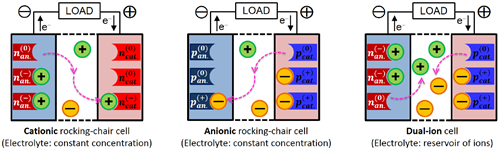
To meet the ever-increasing electricity needs of modern society, and in the absence of a universal storage solution, any safe, clean and reliable means of storing electricity can find practical application today, whatever the scale of energy involved. In this general context, all-organic batteries can provide new energy storage solutions with a smaller environmental footprint. In particular, the development of anion-insertion molecular batteries is of great interest for the deployment of metal-free electrochemical storage systems. Although such a configuration is not possible with most inorganic redox materials (hence the non-development of this field to date), the emergence of new organic redox electrode materials offers a new perspective on electrochemical storage devices.
Within the framework of this Franco-German project, our shared ambition is to promote this type of anionic battery using new organic host structures as electrode materials. Once these materials have been synthesized and characterized, we’ll evaluate their electrochemical performance, particularly in terms of power, given the increased mobility of anions in polar aprotic media. In practice, the new organic electrode materials will be developed and characterized (electrochemically) by Birgit Esser’s group (University of Freiburg, Germany). Suitable electrolytes will be identified and the electrochemical performance of new electrode materials will be evaluated in half-cells. Philippe Poizot’s group (IMN, France) will study the electrochemical and ageing mechanisms of the resulting electrodes using advanced characterization tools (high-resolution TEM, solid-state NMR, DRX operando, etc.). Then, by selecting the best electrode materials tested previously, thick electrodes will be prepared and assembled into complete anionic cells to assess their electrochemical performance, particularly in terms of cycling and power.