

ANR project
Visible-light Photocatalysis with Ambipolar layered CHAlcogenides for Solar fuel generation
Dates:
January 1, 2025 – December 31, 2029
Project coordinator:
Maria Teresa CALDES, IMN, MIOPS team
Partner laboratories:
IMN, SCR, IRCELYON
IMN personnel involved:
Hélène BRAULT (MC UNIV), Eric GAUTRON (IR CNRS), Clément MAHEU (CR CNRS), Stéphane JOBIC (DR CNRS), Camille LATOUCHE (MC UNIV) and Hélène TERRISSE (MC UNIV)
Photocatalysis under visible irradiation with ambipolar lamellar CHAlcogenides for solar fuel production
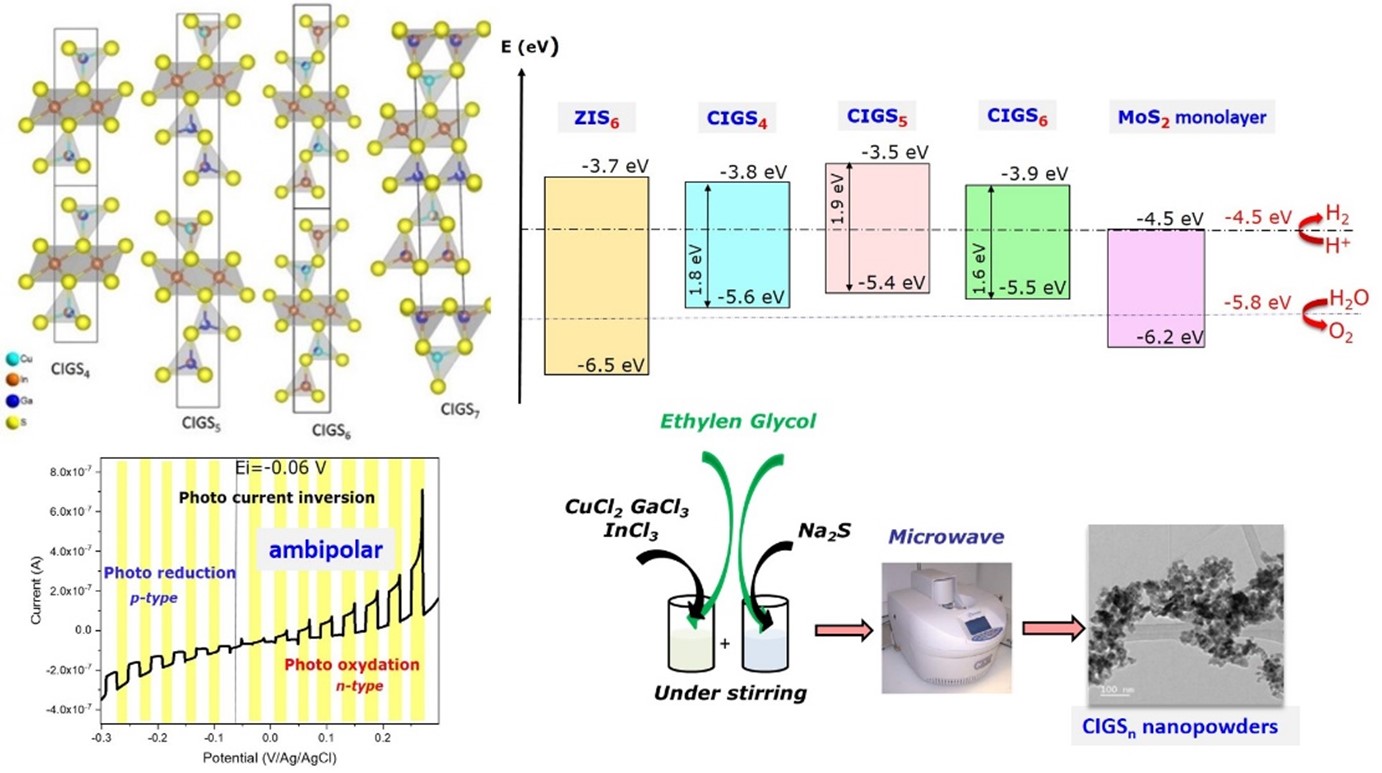
Given the structural kinship between the ZISn and CIGSn phases, the aim of PACHAS is to explore, for the first time, the potential of the new CIGSn compounds and 2D MoS2-CIGSn heterojunctions in visible photocatalysis. We will focus on the water dissociation reaction.
We will start with a “catalyst thickness modulation” approach that will be used to optimize the photocatalytic properties of CIGSn compounds. To this end, CIGSn nanoplatelets will be prepared by exfoliation of CIGSn nanopowders, previously obtained by microwave-assisted solvothermal synthesis.
In a second phase, the “2D heterojunction” strategy will be tested. Ultra-fine MoS2-CIGSn heterojunctions will be prepared by combining MoS2 and CIGSn nanoplatelets either by grinding or using a “one-pot” solvothermal method. PACHAS will finely characterize the HER and OER photocatalytic properties of these materials using co-reagents (S2-, SO32- and S2O62- for HER and S2O82- for OER) adapted to chalcogenide photocatalysts.
By studying the kinetics of these photocatalytic reactions, we will be able to identify the limiting processes involved. The position of the VBM, CBM and Fermi energy levels of the photocatalysts will be determined using a combination of complementary techniques. The energy diagrams thus determined will be compared with the DFT calculations performed to determine the intrinsic properties of MoS2, ZISn and CIGSn.
Next, the interfaces between the MoS2 and ZISn or CIGSn layers will be simulated to obtain information on the thermodynamic stability of the heterojunctions and their type.
Finally, we will attempt to make progress in understanding the relationship between ambipolar behavior and photocatalytic activity, which is not yet developed in the literature.