

ANR project
Hybrid, compact, all-solid-state 3D micro-condenser for low-voltage, rapid-charge electronics
Dates:
October 2022 – November 2026
Project coordinator:
Institut d’Electronique, de Microélectronique et de Nanotechnologie (IEMN Villeneuve-d’Ascq)
Partner laboratories :
- IMN
- Catalysis and Solid Chemistry Unit (UCCS Villeneuve-d’Ascq)
- Center Interuniversitaire de Recherche et d’Ingénierie des Matériaux (CIRIMAT Toulouse)CIRIMAT Toulouse)
IMN staff involved:
Thierry BROUSSE, Laurence ATHOUEL, Olivier CROSNIER, Camille DOUARD, Bernard HUMBERT, Jean LE BIDEAU, Jean-Yves MEVELLEC
Titanium oxide thin films co-alloyed with non-critical metallic and nitrogen elements using a dual process combining PECVD and reactive sputtering
Titanium dioxide was the first material to be tested as an electrode for the photoelectrolysis of water. It is also the most mature material in terms of photo-induced applications (notably photocatalysis). Photo-induced applications imply that the material’s properties derive from exposure to photo-electric radiation such as solar radiation. However, the size of the material’s band gap means that it can only absorb UV radiation, and requires an overpotential to be applied. Unfortunately, these two requirements limit its performance.
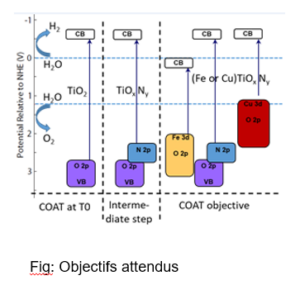
In order to optimize the position of the valence and conduction bands (and thus limit the recombination of photo-generated carriers), it is necessary to prepare titanium oxide thin films by extending the set of substitutions. These substitutions must be made on the oxygen and titanium lattices by non-critical elements such as nitrogen and a transition metal. The aim of COAT will be to develop these new thin films of substituted titanium oxide.
In order to achieve non-equilibrium production conditions, the consortium is using plasma-assisted deposition processes. Plasma-assisted chemical vapor deposition (PECVD) and reactive sputtering (PVD) will therefore be coupled. Deposition conditions will be adjusted with the aim of producing modified titanium oxide films.
The complementary nature of the two approaches lies in the possibility of decoupling the two IMN deposition stages and producing spatially homogeneous samples. The LIST approach, on the other hand, will produce large samples (A4) with a lateral gradient in non-critical element composition. These different approaches will enable combinatorial analysis of properties.
What’s more, the consortium is complementary in terms of the characterizations available. IMN will be responsible for in situ spectroscopic ellipsometry and advanced thin-film characterization. LIST, for its part, will be in charge of photoelectrochemical characterization of electrodes and performance evaluation of water electrolysis under illumination.