

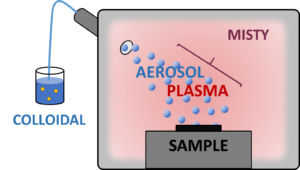
Schematic view of a hybrid process combining PECVD and colloidal solution injection (Simon Chouteau)
Researchers: Benoit Angleraud, Marie-Paule Besland, Aurélie Girard, Agnès Granier, Antoine Goullet, Maryline Le Granvalet, Clément Maheu [2023, ->], Mireille Richard-Plouet, Pierre-Yves Tessier
Contract researchers: Quentin Hatte [2919-2020], Issraa Shahine [2019-2022],
Doctoral students : Sarah Hekking [2023-2026]
Doctoral students who have defended: Maria Mitronika (2020), Simon Chouteau (2024), Julien Chevet (2025)
Combining complex cold plasma processes with chemical approaches opens up a wide range of synthesis possibilities, from nanoporous thin films to nanocomposite films.
In the first area, “Nanoporous materials and nano-objects”, solution chemistry can be used after plasma treatment to nanostructure the layer. The use of specific template substrates is also an interesting possibility for obtaining nano-objects.
In the second axis, “PECVD nanocomposites and solution chemistry”, solution chemistry and the plasma process are truly coupled to develop an innovative hybrid process based on the injection of colloidal solutions at low pressure. The aerosol thus formed enables nanoparticles to be transported within solvent droplets and incorporated into a matrix produced using the organometallic precursor present in the plasma.
Keywords: Nanostructured and nanocomposite thin films, nano-objects, PECVD process, plasma diagnostics, plasma-surface interactions, multi-scale characterizations from macro to nano.
Applications: Dielectric nanocomposites, transparent and flexible conductors, color-controlled light emitters, photocatalysis
Current research projects: ANR PRC ADN
Recent research projects: ANR PRC LuMINA, Pré maturation CNRS OrCAP, Maturation SATT Elec3d
1- Nanocomposites using a hybrid process combining PECVD and solution chemistry
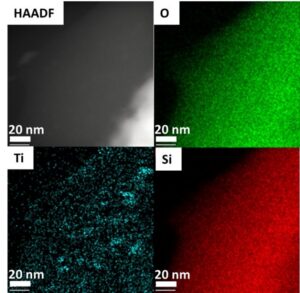
Nanocomposite including TiO2 nanoparticles in a silica matrix transverse view by scanning transmission electron microscopy in HAADF mode and EDX mapping
Researchers: Marie-Paule Besland, Antoine Goullet, Agnès Granier, Clément Maheu, Mireille Richard-Plouet
Doctoral students: Sarah Hekking |2023-2026],
Doctoral students who have defended: Maria Mitronika (2020), Simon Chouteau (2024), Julien Chevet (2025)
The synergy between our “Soft Chemistry” and PECVD skills (link to Thin Film PECVD page) has enabled us to develop and optimize an innovative hybrid process: consisting of injecting a colloidal solution into a low-pressure plasma. Compared with approaches developed at atmospheric pressure, the use of low-pressure plasma enables us to better control and modulate energy transfer to the active species (radicals and ions) in the plasma.
On the other hand, our specificity consists in using colloidal solutions of nanoparticles, NPs, prepared in the laboratory and stable in selected organic solvents, to produce nanocomposite thin films (NCs) formed from NPs dispersed in a matrix.
These TiO2@SiO2 matrix NPs with tunable optical index and dielectric constant are good candidates for the development of integrated passive optical and electrical devices. We have gained an understanding of the transport mechanisms of NPs within droplets, which has enabled us to modulate the nature of the solutions injected in partnership (ANR LuMINA) and to tune the photoluminescence of ZnO NPs, dispersed in a silica matrix. In a second phase, in addition to the nature of the solution, our strategy is to modify the nature of the matrix for photocatalysis applications.
Keywords : Low pressure plasma physics, PECVD process and coupling with solution chemistry, Plasma diagnostics, Droplet-plasma interactions, Plasma-surface interactions
Expertise: PECVD, Solution chemistry, Ellipsometry
Collaborations: LAPLACE (Toulouse), Laboratoire de Chimie de Coordination (Toulouse), Université de Montréal (Canada)
Current research projects: ANR PRC ADN
Recent research projects: ANR PRC LuMINA
Major publications:
Nanocomposite by hybrid process
Handling Nanoparticle Content in Nanocomposite Thin Films Deposited by Misty Plasma Processes through Controlled Flash Boiling Atomization.
Chouteau, S.; Stafford, L.; Granier, A.; Goullet, A.; Richard-Plouet, M. Langmuir 2024. https://doi.org/10.1021/acs.langmuir.3c03176.
2- Nanoporous materials and nano-objects
Researchers: Benoit Angleraud, Aurélie Girard, Maryline Le Granvalet, Mireille Richard-Plouet, Pierre-Yves Tessier
Nanoporous materials: we have shown that the dealloying of ultra-thin layers of gold and copper produces nanoporous gold membranes that can be easily transferred to any type of support. The team is working on their use in transparent conductor applications forflexible electronics and SERS sensors.
Nano-objects: For several years now, the team has been developing approaches to the synthesis of nano-objects (nanowires and nanotubes) based on direct PVD deposition on template substrates, combined with various treatments such as dealloying , the Kirkendall effect or conversion. Studies are focused on understanding the physicochemical phenomena involved at nanometric scales, and on exploiting these phenomena to shape objects in a controlled way at the nanometric scale.
Keywords: Nanomaterials, thin films, dealloying, flexible electronics, plasma sensors, plasma surface interactions
Major publications on the subject: