


Many current and future technologies require energy storage devices with high power ratings and long lifetimes. Supercapacitors, power batteries and hybrid systems between the two meet these criteria.
Research on these devices is aimed at increasing their energy densities while maintaining attractive power densities (50 Wh/kg, 5kW/kg) and high cyclability (> 10,000 cycles). These developments involve research into new electrode materials or the modification of existing ones, as well as an understanding of charge storage mechanisms through advanced in situ or operando characterization techniques coupled with electrochemical studies.
These developments call on solid-state chemistry to design new compounds to meet the specifications, but also on the use of recycled materials, mainly carbon-based. These electrode materials can be combined to design complete cells.
The deposition of these materials in the form of thin films using cold plasma processes (in collaboration with the PCM team) also enables the design of energy storage micro-devices for the Internet of Things, for example. The team’s approach involves 3D micro- and nano-structuring, as well as the use of ionogel electrolytes (collab. PMN team).
Applications: renewable energies (wind, solar, wave generators, etc.), autonomous robotized vehicles in factories 5.0 (AGVs), handling equipment (coupled with fuel cells), micro-sensors, micro-devices, etc.
Keywords: supercapacitors, power batteries, hybrid systems, lithium-ion capacitor, sodium-ion capacitor.
Current research projects:
- European projects: Materials for sustainable sodium-ion capacitors (MUSIC), doctoral program on batteries of the future (DESTINY).
- PEPR Batteries projects (France 2030): targeted High Power and Hybrid Batteries project (HIPOHYBAT, coordination), Franco-German All-Solid Power Batteries project (HIPOBAT).
- ANR projects: Engineering of multifunctional hybrid materials for electrochemical energy storage (HOMERE), 3D hybrid, compact, all-solid-state micro-capacitor for fast-charge high-voltage electronics (MEMPACAP), Engineering of defects in two-dimensional MXene transition metal carbides (2Dfects). 3D electrodes for microsupercapacitors (PERFORM).
People involved: Thierry Brousse (theme coordinator), Laurence Athouël, Olivier Crosnier, Camille Douard, Jérémy Barbé
1- New electrode materials
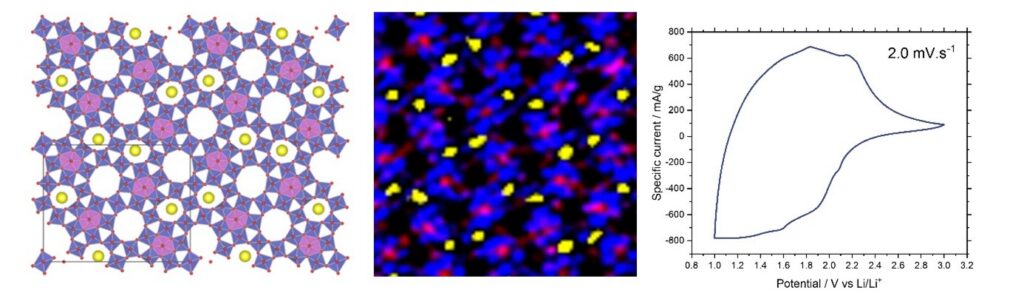
Caption: Crystal structure of H0.25Cs0.5Nb2.5W2.5O14, confirmation of element distribution by STEM-EDX (Cs: yellow, Nb: red, W: blue), voltammogram of an electrode made with this oxide, showing the insertion of lithium in the structure (from: Chem. Mater. 2023, 35, 8, 3162-3171).
Electrode materials for supercapacitors, power batteries and hybrid systems are at the heart of the performance of these devices. Our research focuses on the synthesis by various routes, notably by soft chemistry, of new materials such as multicationic oxides (bronzes, Wadsley-Roth-type phases, …), double lamellar hydroxides, or MXenes, featuring sheet (2D) structures or broad tunnels in different directions. The engineering of vacancies within these materials, introduced through synthesis or heavy-ion beam irradiation at GANIL, also makes it possible to modulate electrochemical properties.
The main objective is to determine the relationship between crystalline structure, microstructure and electrochemical properties. Understanding charge storage phenomena is a major line of research that calls on advanced characterization techniques, notably at the SOLEIL Synchrotron with XAS operando measurements performed using an in situ cell developed in the laboratory. Functionalization of carbons and double lamellar hydroxides with electroactive molecules is also being pursued as a means of significantly increasing electrode capacities. The most relevant electrode materials are integrated into devices or microdevices, in aqueous, organic or ionogel media.
Expertise: Synthesis, modification and structural and microstructural characterization of new materials (oxides, phosphates, etc.) for supercapacitor or power battery electrodes, investigation of charge storage mechanisms using coupled in-situ and operando techniques, integration of synthesized materials into complete devices.
Keywords: Materials chemistry, soft chemistry, lamellar double hydroxides, perovskites, Wadsley-Roth phases, MXenes.
Collaborations
- International : Prof. Bruce Dunn and Prof. Laurent Pilon (UCLA, USA), Prof. J. T. S. Irvine (University of St. Andrews, UK), Prof. Olivier Fontaine (U2M, Canada), Prof. Raul Lucio-Porto (UANL, Mexico).
- Europe: Prof. Andrea Balducci (FSI Jena, Germany), Dr Beatriz Mendoza-Sanchez (KIT, Germany).
- France: Dr Frédéric Favier (ICGM), Prof. Patrice Simon, Dr. Pierre-Louis Taberna et Dr Patrick Rozier (CIRIMAT), Dr. Clara Grygiel et Dr. Isabelle Monnet (CIMAP/GANIL), Prof. Christine Taviot-Guého et Dr. Fabrice Leroux (ICCF), Dr. Gwenaëlle Toussaint and Dr. Philippe Stevens (EDF R&D), Dr. Richard Retoux (CRISMAT), Prof. Vincent Mauchamps, Dr. Simon Hurand and Dr. Marie-Laure David (Institut Pprime), Dr. Stéphane Célarier and Dr. Aurélien Habrioux (IC2MP).
IMN staff involved: Thierry Brousse, Laurence Athouël, Olivier Crosnier, Camille Douard
Research projects
- PEPR Batteries projects (France 2030): targeted High Power and Hybrid Batteries project (HIPOHYBAT, coordination), Franco-German All-Solid Power Batteries project (HIPOBAT).
- ANR project: Engineering of multifunctional hybrid materials for electrochemical energy storage (HOMERE), Engineering of defects in two-dimensional MXene transition metal carbides (2Dfects).
Major publications
- Revisiting Rb2TiNb6O18 as electrode materials for energy storage devices.
Jeronimo Miranda, Etienne Le Calvez, Richard Retoux, Olivier Crosnier and Thierry Brousse. Electrochem. Commun. 2022, 137, 107249 - Hexagonal Tungsten Bronze H0.25Cs0.25Nb2.5W2.5O14 as a Negative Electrode Material for Li-Ion Batteries. Etienne Le Calvez, Julio Cesar Espinosa-Angeles, Eric Gautron, Eric Quarez, Olivier Crosnier and Thierry Brousse. Chem. Mater. 2023, 35, 3162-3171
- Structure and Electrochemical Properties of Bronze Phase Materials Containing Two Transition Metals.
Yunkai Luo, Etienne Le Calvez, Yucheng Zhou, Eric Gautron, Eric Quarez, Molleigh Preefer, Olivier Crosnier, Johanna Nelson Weker, Laurent Pilon, Thierry Brousse and Bruce Dunn.
Chem. Mater. 2023, 35, 8675-8685 - Lithium storage behaviour of AgNbO3 perovskite: Understanding electrochemical activation and charge storage mechanisms. Abbas Khan, Metin Orbay, Nicolas Dupre, Eric Gautron, Etienne Le Calvez, Olivier Crosnier, Andrea Balducci and Thierry Brousse. Energy Storage Materials 2024, 70, 103431
- Electron Delocalization and Electrochemical Potential Distribution Phenomena in Faradaic Electrode Materials for Understanding Electrochemical Behavior. Yachao Zhu, Siraprapha Deebansok, Jie Deng, Xuanze Wang, Thierry Brousse, Frederic Favier and Olivier Fontaine. Adv. Energy Mater. 2024, 14, 2304317
- Improved cycling stability of ferrocene intercalated layered double hydroxides electrodes in aqueous electrolytes. Patrick Gerlach, Camille Douard, Elodie Grange, Laurence Athouel, Julien Sarmet, Philippe Stevens, Gwenaelle Toussaint, Fabrice Leroux, Christine Tavoit-Gueho and Thierry Brousse. Electrochim. Acta 2025, 538, 146962
2- Recycled carbons and derivatives for high-power energy storage devices
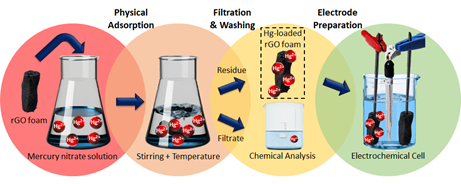
Caption: General diagram of the direct use of an adsorbent for mercury remediation and its subsequent reuse as an electrode for an energy storage device (from: Adv. Energy Sustainability Res. 2025, 6, 2400195).
Carbon-based materials are used in numerous applications, such as carbon-resin composites using carbon fibers for the aeronautics industry, or absorbents used to decontaminate wastewater by capturing heavy metals in solution. At the end of their life cycle, these materials become waste, which is currently rarely recycled. Yet carbons are the basic materials for supercapacitor electrodes, or the negative electrodes of lithium-ion and sodium-ion batteries.
The team’s work focuses on the recycling of various end-of-life carbonaceous materials for energy storage applications. Redurit graphene oxide (rGO) sorbents are used to decontaminate various solutions by capturing lead, mercury and other metal cations. The electrochemical activity of these metals trapped in the carbon nanostructure makes it possible to add a faradic component to the double-layer capacity of carbon for use in supercapacitors, providing a high-value second life for a potential waste product.
Similarly, carbon fibers derived from recycled composites have shown significantly improved power performance compared with the usual hard carbons used in sodium-ion batteries. This has led to the design of sodium-ion capacitors incorporating carbon fibers valued for more than just their mechanical properties.
Expertise: Valorization of carbon-based waste, manufacture of electrodes with end-of-life carbon materials, design of storage systems incorporating these materials, synthesis of sacrificial molecules enabling pre-lithiation or pre-sodiation of negative electrodes.
Keywords: Supercapacitors, sodium-ion capacitor, carbon fibers, graphene, adsorbents, recycling.
Collaborations
- International: Dr. Benjamin Ossonon and Dr. Aliou Pohan (Université Peleforo Gon Coulibaly (UPGC), Côte d’Ivoire)
- Europe: Prof. Patrik Johannson (Chalmers, Sweden), Dr. Maria Arnaiz and Dr. Jon Ajuria (CIC Energigune, Spain).
- France: Julio César De Luca and Yannick Amosse (IRT Jules Verne).
IMN staff involved: Thierry Brousse, Laurence Athouël, Olivier Crosnier, Camille Douard
Research projects
- European project: Materials for sustainable sodium-ion capacitors (MUSIC), doctoral program on batteries of the future (DESTINY).
- PEPR Batteries projects (France 2030) : High Power and Hybrid Batteries project (HIPOHYBAT, coordination).
Major publications
- Designing an electrochemical energy storage device using recycled Ti3C2Tx MXene and reduced graphene oxide spent wastewater adsorbents.. MA Andrade, O Crosnier, P Johansson, T Brousse. Electrochimica Acta 2025, 147176
- Tracking Hg2+ adsorption by reduced graphene oxide in continuous flow by in situ techniques. Marcelo A Andrade, Aram L Bugaev, Alina Skorynina, Camille Douard, Olivier Crosnier, Björn Wickman, Patrik Johansson, Thierry Brousse, Journal of Environmental Chemical Engineering 2025, 118680.
- Energy from Garbage: Recycling Heavy Metal-Containing Wastewater Adsorbents for Energy Storage.
Marcelo A. Andrade, Olivier Crosnier, Patrik Johansson and Thierry Brousse.
ADVANCED ENERGY AND SUSTAINABILITY RESEARCH 2024, 2400195 - The Value Chain of Sustainable Dual Carbon Sodium Ion Capacitors. Roman Mysyk, Daniel Carriazo, Damien Saurel, Maria Arnaiz, Olivier Crosnier, Thierry Brousse, Kangkang Ge, Pierre-Louis Taberna, Patrice Simon, Sander Ratso, Einar Karu, Alberto Varzi, Juan Pablo Badillo, Andrea Hainthaler, Akshaya Sidharthan, Andrea Balducci, Obinna Egwu Eleri, Amaia Saenz de Buruaga, Javier Olarte, Juan Dayron Lopez Cardona, Fatemeh Bahmei, Sebastian P. Bautista, Marcel Weil and Jon Ajuria. Batteries & Supercaps 2025, e202400807.
3- Microsupercapacitors and ionogels
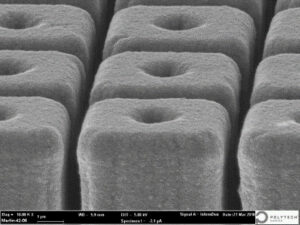
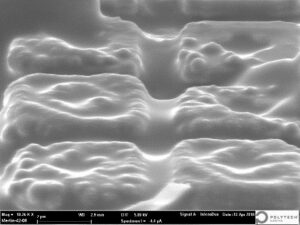
Caption: MnO2 electrode on a substrate microstructured by reactive ion etching, before and after ionogel deposition (after B. Asbani et al 2020 J. Electrochem. Soc. 167 100551).
Energy storage microdevices are considered essential for the development of the Internet of Things (IoT). Energy and power densities must be carefully balanced in these microsystems (>0.5 mWh/cm2, >10 mW/cm2). While microbatteries ensure the autonomy of systems (sensors, micromachines, etc.), microsupercapacitors absorb power peaks during measurement, reception, data transmission, etc. Pseudocapacitive materials, such as vanadium nitride, are the electrodes of choice for this type of microdevice, assembled in symmetrical or asymmetrical configurations.
The electrolyte is often a sticking point, which is addressed in our research in the form of ionogels. These are compatible with microelectronics processes (in particular the “solder-reflow” process) while keeping ionic liquids confined in their solid silica or polymer matrix. These electrolytes are also used in all-solid state batteries.
As with their macro counterparts, microdevices also incorporate power battery electrodes deposited by multi-target sputtering (niobates in particular). Beyond microdevices, the study of thin films of pseudocapacitive materials offers a fundamental approach to charge storage phenomena.
Expertise: Thin film deposition, sputtering, sol-gel deposition,
Keywords: Supercapacitors, power batteries, hybrid systems, lithium-ion capacitor, sodium-ion capacitor, thin films.
Collaborations
- International: Prof. Scott Donne (University of Newcastle, Australia)
- Europe: Prof. Andrea Balducci (FSI Jena, Germany).
- France: Prof. Christophe Lethien (IEMN), Prof. Marielle Huvé and Dr. Pascal Roussel (ICCS), Prof. Patrice Simon and Dr. Pierre-Louis Taberna (CIRIMAT).
IMN staff involved: Thierry Brousse, Jérémy Barbé, Jean Le Bideau, Camille Douard
Research projects
- PEPR Batteries projects (France 2030): Franco-German all-solid power batteries project (HIPOBAT).
- ANR project: Hybrid, compact, all-solid-state 3D microcapacitor for fast-charging high-voltage electronics (MEMPACAP), 3D electrodes for microsupercapacitors (PERFORM).
List of major publications
- Three-Dimensional TiO2 Film Deposited by ALD on Porous Metallic Scaffold for 3D Li-Ion Micro-Batteries: A Road towards Ultra-High Capacity Electrode. Maxime Hallot, Christophe Boyaval, David Troadec, Marielle Huve, Lotfi Benali Karroubi, Sai Gourang Patnaik, Thierry Brousse, Pascal Roussel, David Pech and Christophe Lethien. J. Electrochem. Soc. 2022, 169, 040523
- Solid-state 3D micro-supercapacitors based on ionogel electrolyte: Influence of adding lithium and sodium salts to the ionic liquid. Thibaud Guillemin, Camille Douard, Kevin Robert, Bouchra Asbani, Christophe Lethien, Thierry Brousse and Jean Le Bideau. Energy Storage Materials 2022, 50, 606-617
- In-Depth Investigation of Manganese Dioxide as Pseudocapacitive Electrode in Lithium- and Sodium-Doped Ionic Liquids. Thibaud Guillemin, Camille Douard, Anthony Impellizzeri, Christopher P. Ewels, Bernard Humbert, Christophe Lethien, Scott W. Donne, Jean Le Bideau and Thierry Brousse. J. Electrochem. Soc. 2023, 170, 100531
- Nanofeather ruthenium nitride electrodes for electrochemical capacitors. Huy Dinh Khac, Grace Whang, Antonella Iadecola, Houssine Makhlouf, Antoine Barnabé, Adrien Teurtrie, Maya Marinova, Marielle Huve, Isabelle Roch-Jeune, Camille Douard, Thierry Brousse, Bruce Dunn, Pascal Roussel and Christophe Lethien. Nat. Mater. 2024, 23, 670-679
- The electrochemical performance of Ta2O5 thin films in ionic liquid and ionogel electrolytes.
Patrick Gerlach, Cedric Teyssedou, Jérémie Chaillou, Isabelle Roch-Jeune, Camille Douard, Pascal Roussel, Jean Le Bideau, Christophe Lethien and Thierry Brousse. Electrochim. Acta 2025, 514 - Impact of swift heavy ions irradiation on the microstructural and electrochemical properties of vanadium nitride thin films for micro-supercapacitors. Allan Lebreton, Camille Douard, Clara Grygiel, Isabelle Monnet, Charlotte Bodin, Jonathan Coleman, Christophe Lethien, Jeremy Barbe and Thierry Brousse. Electrochim. Acta 2025, 539, 146963