

Optimist platform
Researchers: Christophe Cardinaud, Rim Ettouri [2023, ->], Aurélie Girard, Cédric Mannequin [2022, ->], Ahmed Rhallabi,
Contract researchers: Felipe Cemin [2022-2024], Guillaume Le Dain [2018-2020], Hiba Beji [2025-2026].
Contract engineer: Thomas le Pape [2023-2025].
Doctoral students who have defended: Tatiana Mbouja Signé [2022-2025], Jack Nos [2021-2024].
Doctoral student : Thomas Le Pape [2025-…]
Plasma etching enables the creation of micrometric or nanometric patterns in a material. It is one of the essential steps in integrated circuit manufacturing processes. Since its birth in the 1980s, its constant development has been one of the driving forces behind the tremendous growth of microelectronics, telecommunications and microsystems technologies. The performance of the final device (microprocessor, memory, sensor, etc.) is closely linked to the nature of the materials used, the size of the etched structures and the quality of the surface finishes obtained.
Our studies focus on fundamental aspects of reaction mechanisms. What species are formed in the plasma? How do they interact with material surfaces? What are the products of these interactions? These are the main questions guiding our studies. These studies, which combine experimental and modeling approaches, have two aims: to understand the physicochemical mechanisms involved in etching, and to master the dimensional control, surface chemistry and physical properties of etched patterns.
Keywords: plasma etching, plasma-surface interaction
Expertise: low-pressure RF cold plasma etching, plasma diagnostics, in situ surface characterization
Applications: microelectronics
Recent and current research projects: PSICRYO, SPOT, OPERA, LoPALEOS, LoPALETiN
Collaborations: CEA/Leti-Grenoble, DGA, GREMI-Orléans, LTM-Grenoble, C2N-Palaiseau, IJL-Nancy
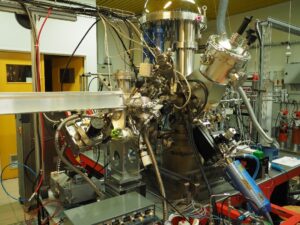
Presentation of etching equipment: “Alcatel” reactor, “Optimist” platform, “Nextral” reactor
1 – Etching at cryogenic temperature
IMN personnel: Christophe Cardinaud, Aurélie Girard, Cédric Mannequin [2022, ->], Ahmed Rhallabi, Rim Ettouri
Contract Researcher : Felipe Cemin [2022-2023]
Doctoral student: Jack Nos [2021-2024]
In addition to the usual field of application for deep silicon etching, cryogenic processes are now showing promise for etching various materials (semiconductors, their oxides and nitrides, low-permittivity materials, etc.) with nanometric pattern dimensions and the need to control the etched depth to the nearest atomic layer (ALE – atomic layer etching).
One of the advantages of cryo-ALE is that the species involved in etching are first physisorbed onto the surface of the cold substrate and then react chemically with it in an argon plasma initiated in the second stage. These steps are then repeated until the desired etching depth is reached.
Achieving these application goals requires progress in understanding the physical and chemical mechanisms involved in the process.
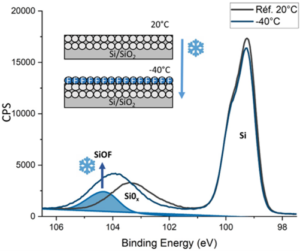
To this end, the study is being carried out on silicon compounds (Si3N4 and SiO2) for different fluorinated gases on the Optimist platform, connected by ultra-high vacuum transfer to an XPS assembly that can be used between -180°C and +100°C.
Keywords: Cyclic plasma etching, cryo-ALE, physisorption, selectivity,
Expertise: Fluorinated plasmas SF6, CF4, C4F8, in situ surface characterization: XPS.
Collaborations: GREMI Orléans, TEL Tokyo and Albany, LTM Grenoble
Recent research projects: Emergence@Chimie OPERA, ANR PSICryo
Major publications:
On the low temperature limits for cryogenic etching: A quasi in situ XPS study.
Felipe Cemin, Aurelie Girard and Christophe Cardinaud.
Appl. Surf. Sci. 2023, 637, 157941
Cryogenic nanoscale etching of silicon nitride selectively to silicon by alternating SiF4/O-2 and Ar plasmas.
G. Antoun, T. Tillocher, A. Girard, P. Lefaucheux, J. Faguet, H. Kim, D. Zhang, M. Wang, K. Maekawa, C. Cardinaud and R. Dussart.
Journal of Vacuum Science & Technology A 2022, 40
Quasi In Situ XPS on a SiOxFy Layer Deposited on Silicon by a Cryogenic Process.
G. Antoun, A. Girard, T. Tillocher, P. Lefaucheux, J. Faguet, K. Maekawa, C. Cardinaud and R. Dussart.
ECS J. Solid State Sci. Technol. 2022, 11, 013013
2 – Modeling and characterizing chlorine plasma etching of steels
IMN staff: Ahmed Rhallabi, Christophe Cardinaud, Aurélie Girard
Contract Researcher: Guillaume Le Dain [2018-2020]
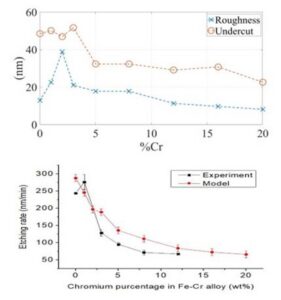
The objective of the ANR SPOT project (Submicron Structuring of Steel by Plasma Etching for Optical Applications and Tribological Optimization) was to develop a reactive plasma etching process for structuring the surface of steel parts. These etchings give structured metal parts enhanced, long-lasting tribological properties for use in harsh environments. As a replacement for more noble, non-recyclable materials, they offer economic and ecological benefits. With this in mind, we have developed an ICP Cl2/Ar plasma etching simulator for steel. The multi-scale approach has the advantage of predicting the spatio-temporal evolution of etched structures through masks as a function of machine parameters. The chemical composition of different types of steel is taken into account in the cellular approach based on the Monte-Carlo method, which studies etching kinetics under flows of reactive neutral species and energetic ions. The effects of parameters such as the chemical composition of steels and the probability of Cl adsorption on certain etching properties such as roughness, lateral overetching and etching speed have been highlighted. Analyses of steel surfaces etched by XPS have enabled us to gain a better understanding of the interaction mechanisms between plasma-derived active species and the steel surface, and consequently to develop a surface model based on the probabilistic Monte-Carlo technique, in line with experimental observations.
Keywords: Plasma, etching, steel, modeling, chlorine
Collaborations: IGL, C2N, SILSEF
Recent research project: SPOT
Major publications:
Etching of iron and iron-chromium alloys using ICP-RIE chlorine plasma.
Guillaume Le Dain, Feriel Laourine, Stephane Guilet, Thierry Czerwiec, Grégory Marcos, Cédric Noel, Gérard Henrion, Christophe Cardinaud, Aurelie Girard and Ahmed Rhallabi.
Plasma Sources Science and Technology 2021, 30, 095022
3 – Etching of vanadium oxide V2O3 in fluorinated plasma
IMN staff: Aurélie Girard, Cédric Mannequin, Christophe Cardinaud
Doctoral student: Tatiana Chancelle Mbouja Signed [2022-2025]
Vanadium oxides are of great interest for electrochromic applications, catalysis and microelectronics. Among them, the compound V2O3 is a Mott insulator, of major interest for ReRAM memory applications and neuromorphic networks. However, no studies on V2O3 etching have been published to date. This project aims to elucidate etching mechanisms by studying reactive ion etching processes using fluorinated plasmas in an inductively coupled reactor.
Our initial investigations demonstrate that V2O3 thin films can be spontaneously etched by exposure to fluorinated plasmas without the addition of ion bombardment. More surprisingly, the addition of ionic bombardment to fluorinated plasma results in an unconventional RIE behavior manifested by a decrease or even, under certain conditions, a cessation of etching for a defined range of ion energies. This phenomenon, not reported in the literature for other materials, is reproducible and controllable, and is at the heart of our study.
Recent research project : Mott-IA project
4 – LoPALEOS: Local approach for Plasma Atomic Layer Etching of Oxide Semiconductors
IMN staff: Cédric Mannequin, Christophe Cardinaud, Aurélie Girard
Contract IE: Thomas Le Pape [2023-2025]
Post-doctorate : Hiba Beji [2025-2026]
The project focuses on the study and development of ALE processes for wide bandgap semiconducting oxides, such as β-Ga2O3, which are attracting attention for their applications in power electronics and optoelectronics.
A local approach, based on in situ plasma and surface diagnostics, is being developed to :
- study the different mechanisms involved in the various stages of any “nth” cycle of the ALE process.
- obtain quantitative information on plasma, reaction probabilities between the species present and the surface, and the exposed surface.
- understand the impact of controllable plasma parameters on the modification and activation stages.
This project covers the instrumentation of etching reactors, enabling the automation of the various reactor components required for the development of cyclic processes, and the local approach methodology at the heart of the study.
The project is financially supported by : I-Site NExT of Nantes University, ANR and the Pays de la Loire Region as part of the “Investissements d’Avenir” program.
Recent research projects: I-Site NExT LoPALEOS project, LoPALETiN project
5 – Etching of chalcogenide glasses
IMN staff: Christophe Cardinaud, Aurélie Girard
Doctoral students who have defended: Thibaut Meyer (2019)
Chalcogenide materials have remarkable properties, paving the way for applications in integrated optics and PCRAM-type non-volatile memories.
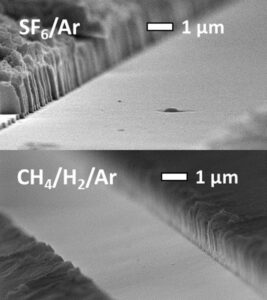
Our work focuses on amorphous GeSbSe compounds, involving the characterization of bulk materials and thin films made from them, as well as the study of etching processes using fluorinated plasma or a CH4-H2-Ar mixture. The aim is to deepen our understanding of the mechanisms involved, and to assess the damage caused and the viability of the processes.
Keywords: GeSbSe, Plasma etching Fluorinated plasmas, CH4-H2 plasmas
Expertise: Fluorinated and CH4-H2-based plasmas, in situ surface characterization: XPS, ellipsometry, plasma diagnostics: optical emission spectrometry, mass spectrometry, electrostatic probes.
Collaborations: IMN-PMN, ISCR-Rennes, KPF-Pardubice
Major publications:
Meyer, A. Girard, G. Le Dain, A. Rhallabi, E. Baudet, M. Baillieul, V. Nazabal, P. Němec and C. Cardinaud, Plasma Sources Sci. & Technol. 32 (2023) 085003.
https://doi.org/10.1088/1361-6595/aceaa5
https://hal.science/hal-04186877v1
Meyer, A. Girard, G. Le Dain, A. Rhallabi, E. Baudet, V. Nazabal, P. Němec and C. Cardinaud, Appl. Surf. Sci. 549, 149192 2021.
https://doi.org/10.1016/j.apsusc.2021.149192
Meyer, G. LeDain, A. Girard, A. Rhallabi, M. Bouška, P. Němec, V. Nazabal and C. Cardinaud, Plasma Sources Sci. Technol. 29(10), 105006 2020.
https://doi.org/10.1088/1361-6595/abb0d0
Sub-themes