


1- Guaranteed calculation of phase diagrams
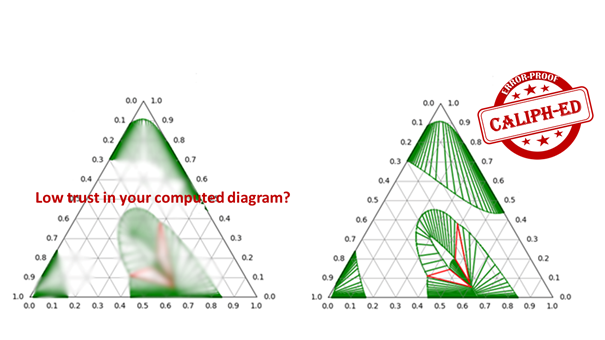
Figure: the CALIPH software developed in collaboration between LS2N and IMN and supported by CNRS Innovation (Prematuration and OPEN programs) is the only one in the world to guarantee the calculation and drawing of binary or ternary diagrams.
Since Sir William Chandler Roberts-Austen’s very first phase diagram in 1875, metallurgical databases have been constantly being expanded to guide understanding and, above all, the search for new alloys with optimized properties. Predictive models (CALPHAD, etc.) and today artificial intelligence tools use these diagrams to make decisions, for example in the context of Integrated Computational Materials Engineering (ICME).
However, for many systems as simple as a binary alloy, it’s easy to spot gaps in the diagrams, such as missing phases, false solubility limits, or even diagrams that are stopped dead in their tracks for no physical reason. The origin of these pitfalls lies in the same calculation method shared by all software – free or commercial – on the academic and industrial market. Until now, the only way out of this rut was to rely on the insight and perseverance of the user.
The new CALIPH software, the result of collaboration between IMN and LS2N, and supported by CNRS Innovation (Prematuration and Open projects) avoids all the above pitfalls: the diagrams drawn are all accurate (no missing phases and exact solubility limits), perfectly reproducible (independent of any initialization) and obtained autonomously, i.e. without recourse to the user. Finally, its calculation times are comparable to those of current software, making it the tool of choice for integration into automated alloy design chains.
Expertise: numerical thermodynamics, ICME
Keywords: thermodynamics, phase diagram, guaranteed calculation
Collaborations: A. Goldsztejn, C. Jermann (LS2N)
IMN employees concerned: Isabelle Braems-Abbaspour
Current research project: CNRS Innovation OPEN program
Publications: APP filing + invention declaration filed
2- Hydrogen embrittlement of metals
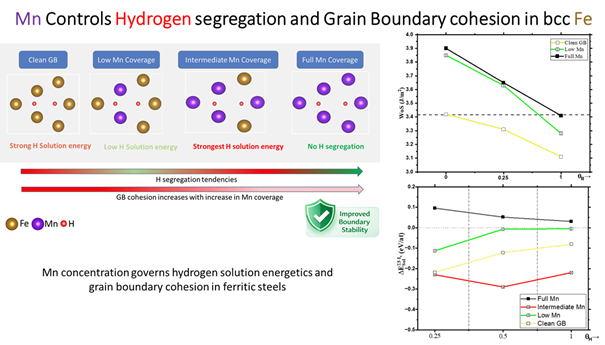
Figure: The crucial role of manganese content in improving the resistance of ferritic steels to hydrogen embrittlement in cryogenic environments (DFT calculations).
Hydrogen embrittlement restricts the use of ferritic steels as storage tanks for liquid hydrogen-rich environments, due to hydrogen-induced decohesion. Using first-principles calculations, we investigate manganese (Mn) cohesion and segregation phenomena and their influence on resistance to hydrogen embrittlement via the mechanical properties of two characteristic grain boundaries Σ5(013)[100] (Σ5) and Σ3(1-12)[110] (Σ3). The importance of microstructure is shown: for Σ5, Mn induces an inversion in hydrogen energetics dependent on Mn content: at low content intrinsic trapping is weakened, intermediate contents deepen traps beyond the pure iron case, and maximum coverage eliminates traps and makes (H) insertion thermodynamically unfavorable. For Σ3, Mn removes H traps monotonically without producing an intermediate stabilization regime.
These results reconcile apparently conflicting findings in the literature, showing that Mn is neither universally embrittling nor universally solidifying; its effects depend on grain boundary structure, concentration and site occupancy. Controlling this content can therefore greatly enhance the strength of ferritic steels for use as liquid hydrogen reservoirs.
Expertise: Thermodynamics, Mechanical Properties, Electronic Structure Calculations, Grain Seals, Segregation
Keywords: Hydrogen embrittlement, hydrogen storage, ferritic steels, DFT calculations
Collaborations: N. Stanford, D. Evans, Future Studies Institute/ University of South Australia (Adelaide, Australia)
IMN staff involved: Ravi Raj, Isabelle Braems-Abbaspour
Major publications (2 submitted) :
- [1] Ravi Raj, Drew Evans, Nikki Stanford and Isabelle Braems , Grain Boundary-specific effects of Mn concentration on hydrogen trapping and embrittlement in bcc Fe: A spin-polarised DFT study, M aterials Science & Engineering A (submitted)
- [2] Ravi Raj, Isabelle Braems, Drew Evans, Ky Nam Mai and Nikki Stanford, Hydrogen Embrittlement Mechanisms in Ferritic Steel at Cryogenic Temperatures under impact loading conditions, International Journal of Hydrogen Energy (submitted)