


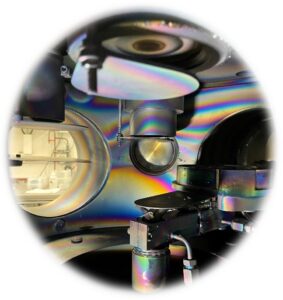
Interior view of a PVD deposition chamber (author: Coline Chartrain)
Researchers: Jérémy Barbé [2021, ->], Marie-Paule Besland, Valérie Brien, Antoine Goullet, Agnès Granier, Pierre-Yves Jouan, Maryline Le Granvalet, Clément Maheu [2023, ->], Cédric Mannequin [2022, ->], Mireille Richard-Plouet, Pierre-Yves Tessier,
Contract researchers: Clément Maheu [2022], Florian Chabanais [2022-2024], Joëlle Zgheib [2021-2023], Dimitri Boivin [2024-2027].
Contract engineer : Thomas le Pape [2023-2025].
Doctoral students: Oumar Toure [2023-2026], Tatiana Mbouja Signé [2022-2025], Pierre-Louis Martin [2021-2024], Léo Seigneur [2024-2027], Coline Chartrain [2024-2027].
Doctoral students who have defended: Joëlle Zgheib (2021), William Ravisy (2021), Michael Rodriguez Fano (2022), Pierre-Louis Martin (2024), Allan Lebreton (2024)
Thin films and coatings with functional properties are produced using plasma-assisted processes [PECVD (Plasma Enhanced Chemical Vapor Deposition) and magnetron sputtering, in continuous, pulsed DC and HiPIMS (High Power Impulse Magnetron Sputtering) modes, or even in multi-pulse mode]. We study the deposition of metallic materials, oxides and nitrides, for their anticorrosion, optical, mechanical, electrochemical, photocatalytic or electronic or ionic transport properties. The aim is to establish a link between the targeted properties, morphological, physico-chemical and structural characteristics of the thin films obtained and the parameters of the deposition process and plasma discharge. The aim is to gain a better understanding of thin-film growth mechanisms and optimize the material for the targeted application.
Applications: photocatalysis, energy conversion and storage, pollution control, temperature sensors, anti-corrosion coatings, micro- and nanotechnologies such as miniaturized components for memory and neuromorphic applications (coll. PMN) or super-capacitors (coll. ST2E).
Key words: Thin films, PECVD process, magnetron sputtering, HIPIMS, plasma diagnostics, metals, nitrides and oxides.
Expertise: Characterization of plasma discharges, design of HiPIMS deposition and feeding reactors, solution chemistry, characterization by XPS and vibrational spectroscopies, spectroscopic ellipsometry, morphological, chemical and structural characterization of thin films (XRD, TEM, SEM, spectroscopies), optimization of thin films for specific properties, correlation of microstructures with specific physical properties.
Current research projects: ANR JCJC PERFORM, PEPR DIADEM – PC – ASTERIX, Projet MITI DauMiNEau (GEPEA), ANR PRC NACELL, ANR PRC BiBOP, MSCA OMATSOLFUEL
Recent projects: CHIPS project (CEA-IMN), ANR PRCI PATIO, ANR PRCE Nanoplast
1 – Deposition of metals, nitrides and composites by DC reactive sputtering and HiPIMS
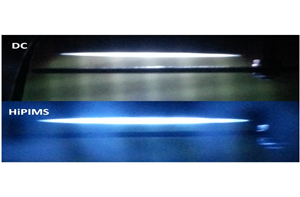
Visualization of Ar/Ti plasma in DC regime (top) or HiPIMS regime (bottom)
Researchers: Jérémy Barbé [2021, ->], Marie-Paule Besland, Valérie Brien, Pierre-Yves Jouan, Antoine Goullet, Clément Maheu [2023, ->], Mireille Richard-Plouet, Rim Ettouri [2023, ->], Ahmed Rhallabi.
Post-Doctorate : Dimitri Boivin [2024-2027] [in French only
Doctoral students who have defended: Joëlle Zgheib (2021)
Reactive sputtering produces films with targeted properties. Optimization is driven by the use of plasma diagnostics and thin-film characterization techniques to understand process/structure/properties relationships and provide feedback to the process.
Deposition, carried out in vacuum and without intentional heating in continuous (DC), high-power pulsed HiPIMS (High Power Impulse Magnetron Sputtering) or even multi-pulse modes, offers great flexibility for the production of films and/or bonding layers of metallic, oxide, nitride or oxy-nitride nature, with stoichiometry control by adjusting deposition parameters.
Depending on the target composition, these layers have applications in the energy field (PV as collector layers for photo-generated carriers, energy storage as electrodes for microsupercapacitors or microbatteries), temperature sensors, anti-corrosion coatings, or layers to reinforce mechanical properties. The contribution of AI to the optimization of deposition conditions is addressed in collaboration with the CEA.
Some of the materials currently being studied are (non-exhaustive list): VN, TiN, NiSi, NiOx, NiNx, ZnO, Cr.
Key words: Thin films, DC magnetron reactive sputtering, RF and HiPIMS, Transition metal coatings, Photovoltaics, supercapacitors, batteries, Anti-corrosion coatings, mechanical properties.
Expertise: Control of plasma parameters to optimize films with targeted properties, plasma diagnostics, microstructural characterization of films and surfaces (XRD, SEM, XPS, ellipsometry, optical and electrical properties).
Collaborations: CEA, GREMI (Tour), LTeN, CEISAM, GEM & GePEA (Nantes), MOLTECH-Anjou (Angers), ISCR (Rennes), IEMN (Lille), IETR, UM6P (Morocco)
Current research projects: PEPR Diadem ASTERIX
Recent projects : CHIPS project (CEA-IMN) Joint thesis with UM6P (Morocco) on gas sensors
Major publications : J. Zgheib, L. Berthelot, J. Tranchant, N. Ginot, M.-P. Besland, et al, Journal of Vacuum Science & Technology A, 2023, 41 (6), pp.063003.
2 – Transition metal oxides and oxy-nitrides by reactive co-sputtering for electrochemical energy storage
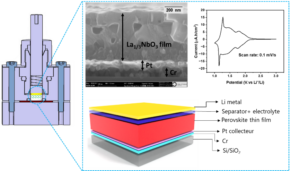
This activity aims to develop functional thin films for micro-supercapacitors or micro-batteries in the field of the Internet of Things, medical implants and miniaturized devices. DC, RF or HiPIMS sputtering is used to design materials with well-controlled chemical and morphological properties for electrochemical storage.
Researchers: Jérémy Barbé [2021, ->], Marie-Paule Besland, Pierre-Yves Jouan, Mireille Richard-Plouet.
Collaboration ST2E team: Thierry Brousse
Doctoral students : Oumar Toure [2023-2026], Léo Seigneur [2024-2027]
Doctoral students who have defended: Allan Lebreton (2024)
The first class of materials studied concerns transition metal nitrides (VN, TiN) as electrodes for supercapacitors. The microstructural (porosity, tortuosity, roughness) and physicochemical properties of these materials are optimized by varying plasma parameters (working pressure, electrical parameters, substrate polarization). The structure-functional property relationships of these materials are highlighted by studying their electrochemical properties.
The second class of materials concerns ion-conducting oxides such as perovskites (La0.66TiO3, La0.33NbO3), Wadsley-Roth (TiNb2O7) or other structures containing facilitated diffusion paths for lithium or sodium. These materials, used as negative electrodes for micro-power batteries, are obtained by reactive co-sputtering of several targets, followed by annealing in a controlled atmosphere. The aim is to gain a better understanding of how lithium is stored in these crystalline structures. In particular, plasma deposition enables us to control compositions and morphologies.
Keywords: Microbatteries and supercapacitors, sputtering, HiPIMS,
Expertise: SEM, XRD, XPS, cyclic voltammetry
Collaborations: IEMN (Lille)
Current research projects: ANR JCJC PERFORM
Major publications:
Control of microstructure and composition of reactively sputtered vanadium nitride thin films based on hysteresis curves and application to microsupercapacitors
3 – TiO2 and TiO2 derivatives thin films by PECVD and reactive sputtering
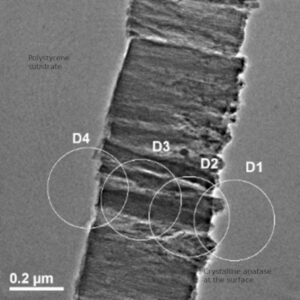
Transverse view of anatase TiO2 film by transmission electron microscopy
Researchers : Marie-Paule Besland, Antoine Goullet, Agnès Granier, Maryline Le Granvalet, Clément Maheu [2023, ->], Mireille Richard-Plouet
Post-doctoral researcher: Florian Chabanais [2023-2024]
Doctoral students who have defended: William Ravisy (2021)
Our expertise in the PECVD process (low-pressure, inductively coupled RF plasma) for depositing thin films from organometallic precursors enabled us to optimize the process to synthesize photo-catalytic TiO2 thin films on polymers at low temperatures by applying RF power in pulsed mode. High-resolution transmission electron microscopy (TEM) analysis revealed a thin film with columnar morphology, fully crystallized in anatase form in continuous mode (T=130°C) and crystallized only at the film surface in pulsed mode (T < 80°C).
Recently, the possibility of bandgap engineering by modifying the TiO2 lattice through the incorporation of alliovalent ions such as tungsten or nitrogen has been tested, either by adding an organometallic W precursor in a PECVD process, or by sputtering a metal target and adjusting the Ar/O2/N2 reactive gases. The aim is twofold: (1) to optimize photon collection and charge separation of photo-generated carriers to enhance the photocatalytic performance of anatase thin films, which absorb only in the UV; (2) to adjust the position of the valence band and conduction band according to the photocatalytic reactions targeted. This is particularly the case in the European OMATSOLFUEL project, which focuses on new photo-oxidation reactions. It is therefore relevant to engineer the band gap of TiO2 by adding nitrogen. The resulting TiO2 and TiOxNy thin films and their interfaces with co-catalysts are characterized by XPS measurements.
Keywords: Low-temperature PECVD process, organometallic precursors, photo-catalytic thin films, plasma-surface interactions
Expertise: PECVD, XPS surface analysis, MET, Ellipsometry
Collaborations: LIST (Luxembourg), IRCELYON, GEPEA
Current research projects: ANR PRC NACELL, MITI DauMiNEau Project, MSCA OMATSOLFUEL
Recent research projects : ANR PRCI PATIO
Major publications on the subject:
Photocatalytic anatase TiO2 deposition by pulsed plasma PECVD
Photocatalytic anatase TiO2 PECVD deposition on polymers
Effect of ion bombardment on the structure and optical properties of PECVD-deposited TiO2 thin films
4 – Mott materials with resistive transition
Researchers: Marie-Paule Besland, Pierre-Yves Jouan, Cédric Mannequin [2022–>], Aurélie Girard
Collaboration PMN Team: Laurent Cario, Etienne Janod, Benoit Corraze, Julien Tranchant
Contract engineer: Thomas le Pape [2023-2025].
Doctoral students: Tatiana Mbouja Signed [2022-2025]
Doctoral student who defended: Michael Rodriguez Fano (2022)
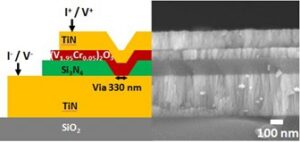
Following on from the discovery made at IMN, we are exploiting the possibility of inducing a non-volatile, reversible resistive transition by electrical pulse in a broad class of materials: Mott materials [Patents 2007, 2012]. The resistive switch properties induced by an electrical pulse have been validated on GaV4S8 and V2O3 : Cr (25-500 nm) thin films obtained by MS (Magnetron Sputtering) [Patent 2009]. These materials are now being considered as an emerging technology for memory applications [Adv. Func. Mat., 2015] and neuromics [Adv. Func. Mat., 2017]: Mott-RAM technology.
In order to master the plasma etching process required to downsize devices, a study has been undertaken to understand the reaction mechanisms of reactive ion etching by fluorinated plasmas of these V2O3 thin films. The aim is to be able to propose optimized and efficient etching conditions.
Keywords: Thin films, magnetron sputtering, controlled atmosphere annealing
Collaborations: SPS sputtering targets (Plateforme PNF2 Toulouse, CIRIMAT)
Current research projects: Mott-IA project
Major publications:
Review of IMN work on Mott materials
Mott materials for neuromorphism
Properties of thin-film V2O3:Cr
5 – Al-X-N-O layers by magnetron sputtering
Researchers: Valérie Brien, Pierre-Yves Jouan, Mireille Richard-Plouet
Doctoral student who defended: Pierre-Louis Martin [2021-2024]
The aim of this activity is to develop and optimize new compounds in the form of thin films with specific antibacterial photocatalytic properties, to combat nosocomial diseases.
Films of Al-X-N-O composition are produced by magnetron sputtering, a deposition technique widely used in industry, which enables the nature, nanostructuring and morphology of the films to be controlled via plasma parameters.
Synthesis and structural, chemical, morphological and surface characterization are carried out at IMN. The antibacterial properties and mechanisms of the films are studied at the Laboratoire de Chimie Physique et Microbiologie pour les Matériaux et l’Environnement, LCPME (Nancy). Phase stability and electronic structure are evaluated by DFT calculation at the University of Thessalonica (Greece). These simulations provide us with elements for understanding the properties.
Keywords: Oxy-nitride, nitride, antibacterial, MET
Expertise: Morphological and chemical characterization of thin films, Transmission Electron Microscopy, DRX, Physical-chemical correlations of thin films and macroscopic properties
Collaborations: LCPME (Nancy), IJL (Nancy), Synchrotron Soleil (Saclay), University of Strathclyde (Scotland, UK), EPFL (Switzerland), Synchrotron Diamond (Oxford, UK), University of Thessaloniki (Greece).
Sub-themes
- 1 – Deposition of metals, nitrides and composites by DC reactive sputtering and HiPIMS
- 2 – Transition metal oxides and oxy-nitrides by reactive co-sputtering for electrochemical energy storage
- 3 – TiO2 and TiO2 derivatives thin films by PECVD and reactive sputtering
- 4 – Mott materials with resistive transition
- 5 – Al-X-N-O layers by magnetron sputtering