


This theme addresses the design, characterization and manipulation of individual nano-objects and nanopores, either to understand and develop the objects themselves, or as test systems for new methods of nanoscale characterization and manipulation.
1 – Nanocarbon design
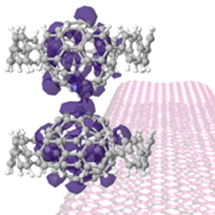
The design of new families of nanocarbon materials, from “bottom-up” approaches (notably for carbon nano-rings, CPPs, and azafullerenes), to the chemical and structural modification of existing nanocarbons, such as the selective filling of cavities in collapsed carbon nanotubes. We are also interested in the processes by which carbon nanostructures are formed (such as fullerenes in space), and the ways in which different nanostructures can be modified (e.g. dislocation cores).
In addition to the nanocarbons themselves, we are innovating in the ways nanocarbons can be used as templates, creating previously unknown material phases through nanoconfinement (for example, inside carbon nanotubes).
The PMN team relies heavily on computer modeling tools and local, national and international collaborations.
Key words: Nanocarbon, Fullerene, CPP, Nanotube, Nanoconfinement.
IMN people involved: C. Ewels, J.-L. Duvail, M. Bayle, B. Humbert
Applications: Nanocarbon design, confined ionic liquids, ionogels, sub-micron optical resolution, 3D characterization and visualization of nanoporous materials, electro-optical nanocomposites, (multi)functional nanowires and nanotubes.
2 – Confined ionic liquids, ionogels
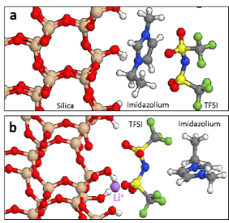
The confinement of ionic liquids makes it possible to exploit the properties of ionic liquids while benefiting from solid shaping. Diffusion properties in the resulting nanoporous ionogels (nanopores seen here as “inverse nano-objects”) are similar to those of liquids. By varying the chemical and topological characteristics of numerous ionogels, we have extended our understanding of behavior at the ionic liquid/host lattice interface by examining the dynamics of the ions, their interactions with each other, and their interactions with the host lattice. We are focusing on the fundamental understanding of self-organization, anomalous diffusion and surface-liquid interaction in these nanoconfined environments, with technological implications (energy storage and optical devices).
Key words: Ionic liquids, diffusion, modeling, energy storage applications
IMN people involved: J. Le Bideau, Y. Claveau, B. Humbert, M. Bayle, C. Ewels
3 – Sub-micron optical resolution
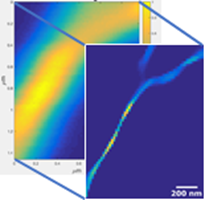
In recent years, major advances in our knowledge of nano-objects have come mainly from the improved resolution of spectroscopic, microscopic and modeling techniques towards the atomic scale. Our project is based on the idea of combining our expertise in these techniques to achieve a complete understanding of the physical properties of individual nano-objects at the atomic scale. This approach strongly combines experiment and modeling. To find out more: [ Super-resolution],[Nanowire super-resolution].
Key words: Nano-objects, Plasmonics, Super-resolution.
Persons concerned : B. Humbert, M. Bayle, J.-L. Duvail, C. Ewels
4 – 3D characterization and visualization of nanoporous materials
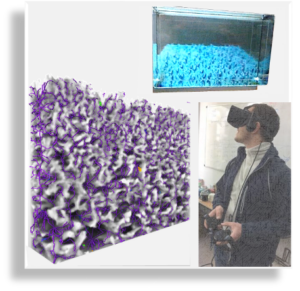
Pores are 3D elements, which require 3D characterization and visualization methods. We perform structural and chemical characterization of porous polymeric materials using 3D reconstructions of focused ion beam/SEM data, and study interactions between these materials and biomolecules. We are also developing methods for visualizing and interacting with 3D objects using 3D visualization tools such as the holographic desktop screen (looking glass factory), VR headsets (Occulus Rift, …) and dynamic inputs (Kinect, LeapMotion, …).
Key words: 3D reconstruction, 3D visualization.
IMN people involved: P. Abellan, C. Ewels