

Permanent staff :
- MIOPS team : C. Latouche, S. Jobic
- ID2M team: I. Braems, F. Tancret,
- PMN team: C. Ewels, A. Mokrani, Y. Claveau
- PCM team: A. Rhallabi, R. Ettouri
- ST2E team: F. Boucher, P. Moreau,
- IT staff: F. Vivet, V. Degat, G. Willer
The role of the cross-team axis is to share knowledge and expertise in the field of modeling. It also manages the laboratory’s high-performance computing resources. Management relies in particular on the know-how and skills of members of the cross-team modeling axis for hardware and software choices concerning the shared computing cluster and additions to the regional mesocenter. Members of the modeling axis meet around ten times a year for in-house seminars, and use digital tools to exchange ideas on an ongoing basis.
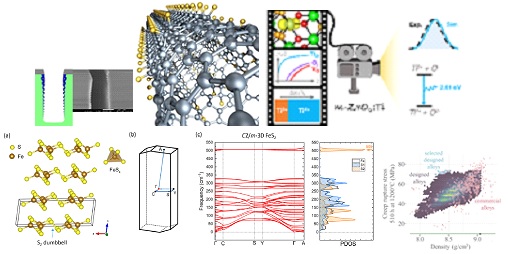
The laboratory’s transverse modeling axis brings together around ten permanent members from the laboratory’s 5 teams and as many non-permanent members. They use a wide range of digital tools:
- DFT-based atomistic simulations (VASP, WIEN2k, CRYSTAL, AIMPRO, etc.),
- Larger-scale simulations, such as molecular dynamics and Monte Carlo methods (in-house codes, LAMMPS, GULP),
- Modeling of cold plasma processes for etching and material deposition ( PTSI simulator for silicon etching using the Bosch process – MicroTools simulator for deposition and etching: in-house codes)
- Materials prediction calculations (evolutionary algorithms: in-house and USPEX codes, deep/machine learning and data mining with python and the TensorFlow and Keras libraries, Calphad Thermo-Calc software),
- Machine learning and AI techniques (development of machine learning potentials, MLIPS, etc.).
We use :
- internally, a parallel computing cluster (Tier 3, 500 cores) whose resources are shared and the costs of updates are pooled between groups.
- the GLICiD mesocenter Groupement Ligérien pour le Calcul Intensif Distribué (Tier 2), hosted by Nantes Université.
- Tier 0 computing centers (over 7 million computing hours).
We have close links with the developers of some of these software packages (VASP, WIEN2k, AIMPRO, USPEX, etc.), ensuring ongoing access to the latest developments. We also develop in-house modeling software (plasma and etching codes, Monte Carlo), post-processing software (PyDEF) and guaranteed calculation software (CalIPh in collaboration with LS2N) that are open to the community, while others are sometimes directly transferred to industry.
IMN research topics in modeling :
- Calculation of electronic structures and derived physico-chemical properties
- Support for the laboratory’s experimental characterization (UV-vis, luminescence, NMR, EELS, FTIR/Raman, HRTEM ….).
- Development of dedicated software (PyDEF, CalIPh) and 3D visualization tools
- In silico materials prediction and design: nanometric structures (nanocarbons, nanowires, interfaces), crystalline phases (metastable compounds from soft chemistry), combinatorial optimization of metal alloys, structure/property prediction on hybrid materials.
- Thermodynamics of defects (points, interfaces, dislocations)
- Dynamics, kinetics (Molecular dynamics, Monte Carlo, …)
- Process modeling (multi-scale modeling of plasma etching, plasma discharge for physical vapor deposition (PVD))
- Multiphysics modeling (energy management of an autonomous UAV in flight, COMSOL, etc.)
Organizing activities :
The axis also :
- participated in the creation and organization of the CNRS RaProChE Thematic School (Roscoff, 2018), which brought together several disciplines around electronic structure.
- In 2010, we launched the biennial ICAMM (International Conference on Advanced Materials Modelling), which now attracts around a hundred people in person and a community of several hundred on social networks. The conference is organized every two years in conjunction with ISCR Rennes. It is coupled with a workshop on a specific calculation software for which members of the axis are tutors.
- organized several other regional, national and international modeling conferences since 2015.
Collaborations :
Finally, we regularly welcome researchers to IMN: Pr. Xavier Gonze (Louvain-La-Neuve), Dr. Khang Hoang (North Dakota State University, Fargo, USA), Dr. James McHugh (Loughborough University UK), Dr. Dogan Erbahar (Gebze Technical University, Kocaeli, Turkey)…
We also have strong collaborations with other external modeling groups, including: P. Briddon (Newcastle UK), K. Jolley (Loughborough, UK), P. Rivera (Lancaster, UK) D. Erbahar (Turkey), D. Rybovskiiy (Skoltech), I. Suarez (Australia), G. Lee (S. Korea), M. Whangbo (USA), K. Hoang (Fargo), A. Zobelli (LPS Orsay), G. Frapper (IC2MP, Poitiers), P. Ganster (LGF, Saint Etienne), J. Vidal (EDF), X. Rocquefelte (ISCR), D. Jacquemin (CEISAM), G. Ramstein (LS2N), A. Goldszteijn (LS2N), C. Jermann (LS2N).
Industrial collaborations include STMicroelectronics, EDF, CEA, Réseau Transport Électrique de France (RTE), X-Sun…