

ANR project
Ultrafast Phase Transition Induced by Strain Waves in Correlated Materials
Dates:
From October 1, 2026, to September 30, 2030
Coordinator Laboratory of the project: Institut de Physique de Rennes (IPR, UMR 6251)
Project Coordinator: Marina SERVOL, Assistant Professor
IMN Project Coordinator: Benoît CORRAZE, PMN Team
Partner laboratories:
- IPR (UMR 6251 CNRS/Université de Rennes 1)
- GREMAN (UMR 7347 CNRS/Université de Tours)
- IMN (UMR 6502 CNRS/Nantes Université)
Persons of IMN involved:
Benoît CORRAZE (Assistant Professor), Etienne JANOD (CNRS Research Director), Laurent CARIO (CNRS Research Director)
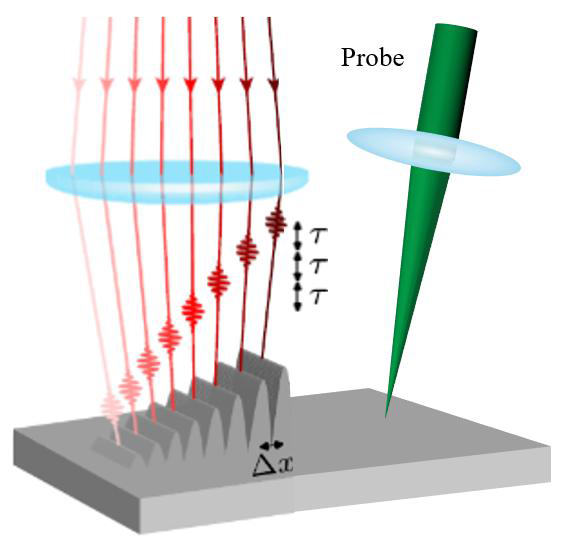
Phase transitions can be induced either at equilibrium by a gradual change in pressure or temperature, or by impulsive control parameters such as ultrashort optical or THz pulses, or even microsecond pulses such as electrical ones. In these fast or ultrafast dynamic situations, the direct effects of the control parameter are not the only phenomena involved in the transition. Whether it is the electronic excitation from the optical pulse, the ultrafast local electric field of the THz pulse, or the macroscopic electric field of an electrical pulse, the impulsive nature of the excitation generates local deformation of the crystal lattice and induces an elastic wave that displaces the atoms. In this way, the interactions between atomic potentials are modulated, and metastable states with different—and possibly novel—physical properties can arise. This can trigger or amplify the phase transition. The involvement of these elastic effects is therefore universal, and studying them has led to a better understanding of out-of-equilibrium phase transitions, which are far less well understood than those at equilibrium. Thus, in recent years, several studies in the field of photoinduced phase transitions (PIPT) have revealed the nature of the strain wave and its effect on matter. They have begun to uncover a variety of behaviors. In the Mott insulator Ca₂RuO₄, the final electronic transformation in the PIPT from the insulating to the metallic state occurs after the isosymmetric lattice rearrangement. In other compounds, such as trititanium pentoxide Ti₃O₅, the strain and the phase transition fronts propagate simultaneously. In the case of a granular film of chromium-doped vanadium sesquioxide, V₂O₃:Cr—another Mott insulator compound—the insulating-to-metallic phase transition (IMT) below 160 K involves a breaking of symmetry. The corresponding PIPT involves a shear wave accompanying the transition at the grain scale, followed by a longitudinal wave propagating the transition across the entire film. To date, no study has focused on driving an ultrafast transition solely through the propagation of a moderate strain: either the transition is initiated by photoexcitation, or the strain occurs in the high-deformation regime of a shock, resulting in a non-volatile transition. In this project, we aim to implement a novel approach to drive a volatile phase transition specifically using a pure, well-controlled strain wave, independent of the influence of the initial pulse, and thus from the initial locally induced precursors to the macroscopic transition that it may create.