


1 – Inorganic materials and photovoltaic devices
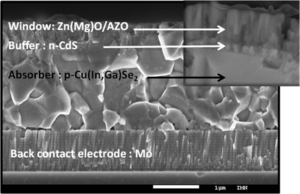
Scanning electron microscopy image of the cross-section of a Cu(In,Ga)(Se,S)2 solar cell. The stack of four thin layers deposited on a glass substrate is no more than 3 µm thick, and converts more than 20% of solar radiation into electrical energy. Such a structure can also be deposited on plastic or metal foil substrates.
Photovoltaic conversion converts solar energy into electrical energy. To date, crystalline silicon (c-Si) technology accounts for over 95% of the global market. However, this technology will reach its industrial efficiency limits by 2030, and is unable to optimally cover all user needs (niche markets such as flexible and lightweight panels, indoor). The photovoltaic technology we are working on is based on thin films of chalcopyrite-structured chalcogenide materials, namely Cu(In,Ga)(Se,S)2. It enables conversion efficiencies of over 23% to be achieved in the laboratory, and offers a number of advantages. In addition to its low material consumption and structural simplicity, the Cu(In,Ga)(Se,S)2-based cell can be fabricated on plastic sheets, and its optical absorption range can be adapted to tandem or indoor cell applications. The aim of our work is to develop knowledge and concepts relating to these two types of application.
Expertise: Thin-film synthesis processes; structural, optical and electronic properties of materials; properties of surfaces and interfaces.
Key words: Photovoltaics, thin films, chalcogenides, characterization
Collaborations :
- National: IPVF, C2N, Institut FOTON, INL-Lyon, CRHEA, CEA-INES
- International: University of Münster, Warsaw Polytechnic, IES Madrid, HZB Berlin
- Companies: B-Plan, AVANCIS
IMN people involved: Nicolas BARREAU, Ludovic ARZEL, Thomas LEPETIT, Sylvie HAREL
Projects : ANR SIPHON, PEPR TASE-IOTA, PEPR TASE-MINOTAURE, ADEME PRINCIPE, Europe SITA, Europe PARACELSIS
Major publications:
- Choubrac, L., Bertin, E., Pineau, F., Arzel, L., Lepetit, T., Assmann, L., … & Barreau, N. (2023). On the role of sodium and copper off-stoichiometry in Cu(In,Ga)S2 for photovoltaic applications: Insights from the investigation of more than 500 samples. Progress in Photovoltaics: Research and Applications, 31(10), 971-980. (https://doi.org/10.1002/pip.3701)
- Barreau, N., Bertin, E., Crossay, A., Durand, O., Arzel, L., Harel, S., Lepetit, T., … & Lincot, D. (2022). Investigation of co-evaporated polycrystalline Cu(In,Ga)S2 thin film yielding 16.0% efficiency solar cell. EPJ Photovoltaics, 13, 17. (https://doi.org/10.1051/epjpv/2022014)
- Lepetit, T., Harel, S., Arzel, L., Ouvrard, G., & Barreau, N. (2017). KF post deposition treatment in co-evaporated Cu(In,Ga)Se2 thin film solar cells: Beneficial or detrimental effect induced by the absorber characteristics. Progress in Photovoltaics: Research and Applications, 25(12), 1068-1076.
- Lepetit, T., Harel, S., Arzel, L., Ouvrard, G., & Barreau, N. (2016). Coevaporated KInSe2: a fast alternative to KF postdeposition treatment in high-efficiency Cu(In,Ga)Se2 thin film solar cells. IEEE Journal of Photovoltaics, 6(5), 1316-1320.
2 – Photo(electro)catalysis / Solar fuels
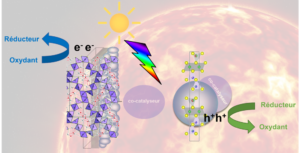
Using a materials chemistry approach, the Institut des Matériaux de Nantes Jean Rouxel (IMN) is developing semiconductors for the conversion of solar energy into high value-added molecules. In particular, the MIOPS team is working on new mixed chalcogenide and anion materials. Research focuses on photocatalytic and photoelectrocatalytic devices for hydrogen production, CO₂ reduction or N₂ upgrading. To this end, we mobilize a variety of synthesis approaches (vacuum co-evaporation, solid-state, soft chemistry), combined with advanced characterization tools (X-ray diffraction, electron microscopy, XPS spectroscopies, optical analyses) and ab initio modeling of electronic and optical properties. This complementary approach enables us to better understand the fundamental conversion mechanisms and optimize the performance of photoactive materials to meet today’s energy and environmental challenges.
Expertise: vacuum co-evaporation deposition, solvothermal synthesis, microwave synthesis, sol-gel synthesis, XRD characterization, MET/MEB characterization, XPS characterization, optical measurements, photocatalytic test, photoelectrocatalytic test
Key words: Materials, Electronic structure engineering, Solar fuels, Photocatalysis, Photoelectrocatalysis.
Collaborations: Chimie Et Interdisciplinarité, Synthèse, Analyse, Modélisation (CEISAM), Institut des Sciences Chimiques de Rennes (ISCR), Institut de recherches sur la catalyse et l’environnement (IRCELYON), Institut Parisien de Chimie Moléculaire (IPCM), Institut de Chimie et Procédés pour l’Energie, l’Environnement et la Santé (ICPEES), TU Darmstadt
IMN employees involved: Nicolas Barreau, Hélène Brault, Maria Teresa Caldes, Sylvie Harel, Stéphane Jobic, Houria Kabbour, Camille Latouche, Clément Maheu
Ongoing research projects: GreeNH3 (PEPR, 2022-2026), OMATSOLFUEL (MSCA-PF, 2023-2025), Power-CO2 (PEPR, 2023-2029), GASPER (ANR, 2024-2028), PACHAS (ANR, 2025-2029)
Major publications:
- V. Nikolaou, D. Romito, C. Maheu, J. Hamon, E. Gautron, F. Massuyeau, S. Jobic, F. Odobel, Dual solar-driven hydrogen evolution and alcohol oxidation with CdS quantum dot-sensitized photocatalysts prepared by the SILAR methodology, Journal of Materials Chemistry A, 2024, 12, 30885-30891.
- A. Belhcen, A. Renaud, C. Guillot-Deudon, L. Arzel, B. Corraze, N. Barreau, S. Jobic, M. Teresa Caldes, Photo-electrochemical characterization of CIGSn lamellar compounds: potential candidates for photoinduced applications, Electrochimica Acta, 2025, 511, 145391.
- S. Al Bacha, S. Saitzek, H. Kabbour, E. E. McCabe, Iron Oxychalcogenides and Their Photocurrent Responses, Inorganic Chemistry, 2024, 63, 7, 3292-3302.
- P.B. Pati, R. Wang, E. Boutin, S. Diring, S. Jobic, N. Barreau, F. Odobel, M. Robert, Photocathode functionalized with a molecular cobalt catalyst for selective carbon dioxide reduction in water, Nature Communications, 2020, 11, 3499.
- H. Ichou, L. Choubrac, G. Suna, D. Sarkar, P. J. Marques Cordeiro Junior, S. Diring, F. Pineau, J. Bonin, N. Barreau, M. Robert, F. Odobel, Hybrid CIGS-Cobalt Quaterpyridine Photocathode with Backside Illumination: A New Paradigm for Solar Fuel Production, Angew. Chem. Int. Ed. 2025, 64, e202423727
3 – Inorganic materials and photovoltaic devices
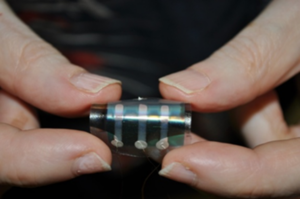
Photograph of an organic solar cell fabricated on a plastic substrate
Develop and study original indium-free electrodes based on a technology that does not require high-temperature treatment or aggressive processes, is compatible with the use of a flexible substrate, and enables large-scale technology transfer to the flexible electronics industry, for applications in photovoltaics and semi-transparent PV for integration in “smart” buildings. Our research is organized along two axes: (i) transparent conductive and flexible indium-free electrode, (ii) active layer (aiming for a fullerene-free layer).
Expertise: Vacuum thin film deposition, Electrical characterization, Optical characterization, Physico-chemical characterization
Keywords: Organic photovoltaic cells, Transparent conductive and flexible electrodes, interface layers, semi-transparent PV, building integration
IMN people involved : Linda CATTIN, Guy LOUARN
Ongoing research projects: PHC Imothep, IFCAR/ CEFIPRA
Major publications:
- Facile enhancement of bulk heterojunction solar cells performance by utilizing PbSe nanorods decorated with graphene. El-Menyawy, EM; Cattin, L; (…); Arzel, L. Oct 1 2019 JOURNAL OF COLLOID AND INTERFACE SCIENCE 553 , pp.117-125
- Graphite-Based Localized Heating Technique for Growing Large Area Methylammonium Lead Bromide Single Crystalline Perovskite Wafers and Their Charge Transfer Characteristics. Gandhi, MB; Mohan, A; (…); Padmanabhan, P, Mar 4 2025, ACS OMEGA 10 (10) , pp.10220-10229
- Low temperature synthesis of MoS2 and MoO3:MoS2 hybrid thin films via the use of an original hybrid sulfidation technique. Ftouhi, H; Lamkaouane, H; (…); Cattin, L. Aug 2022, SURFACES AND INTERFACES
- Electrochemical fabrication of poly (Indole-6-carboxylic acid) nanowires adorned with nanorod MnO2 for evaluation of its capacitive properties. Lorca-Ponce, J; Cisterna, J; (…); Ramírez, AMR, Oct 1 2023, ELECTROCHIMICA ACTA
- Semi-transparent organic photovoltaic cells with dielectric/metal/dielectric top electrode: Influence of the metal on their performances. Nanomaterials 2021, 11(2), 393; https://doi.org/10.3390/nano11020393
- On the use of multiple stacked active layers in organic photovoltaic cells. J Mater Sci 55, 9762-9774 (2020). https://doi.org/10.1007/s10853-020-04568-9
- New dielectric/metal/dielectric electrode for organic photovoltaic cells using Cu:Al alloy as metal, Journal of Alloys and Compounds, 819, 2020, 152974. http://www.elsevier.com/locate/jalcomhttps://doi.org/10.1016/j.jallcom.2019.152974