


The development and study of complex materials with remarkable electrical properties, such as insulator-to-metal transitions (resistive transitions, Mott insulators and RRAM applications) induced under electric fields.
1 – Synthesis and shaping of quantum materials: from crystals to thin films
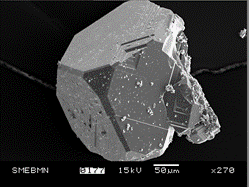
This work involves the synthesis of powders, crystals and thin films of quantum materials. From a fundamental point of view, shaping has an impact on the response to stimuli and on the properties observed. Our mastery of the various synthesis routes thus broadens the possible field of investigation of physical properties. We are also developing thin films for use in devices.
Our expertise focuses on the synthesis of a particular class of quantum materials, namely transition metal chalcogenides and oxides. This expertise is employed in a network of national and international collaborations. We also carry out exploratory synthesis of new compounds in collaboration with the chalcogenide axis.
For more information:[TaS2],[GaV4S8],[V2O3],[Misfit]
Key words: Crystals, Thin films.
IMN people involved : L. Cario, E. Janod, B. Corraze, J. Tranchant, S. Sasaki
2 – Non-equilibrium Mott insulators, insulator-metal transition and elastic effects
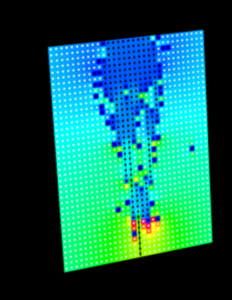
The work focuses on the study of a large class of highly correlated materials, Mott insulators. The team is interested in the properties that emerge in these materials when they are brought out of equilibrium, for example via an ultrafast electrical or light pulse. Such excitations can induce non-equilibrium phase transitions. These involve both a strong electronic response (insulator-to-metal transition) and a lattice response (volume change). An intriguing aspect is that these non-equilibrium transitions may be only transient and relax after the perturbations, but can become permanent, locking the material into a new metastable state potentially inaccessible to thermodynamic equilibrium.
In this context, our work aims to understand the mechanisms by which hot electrons are created, the dynamics of the insulator-metal transition and the associated elastic effects.
Find out more:[Mott]
Keywords: Mott insulator, insulator-metal transition, non-equilibrium phase transition, resistive transition, elastic effect
People involved: E. Janod, L. Cario, B. Corraz, J. Tranchant
3 – Mottronics & neuromorphic systems
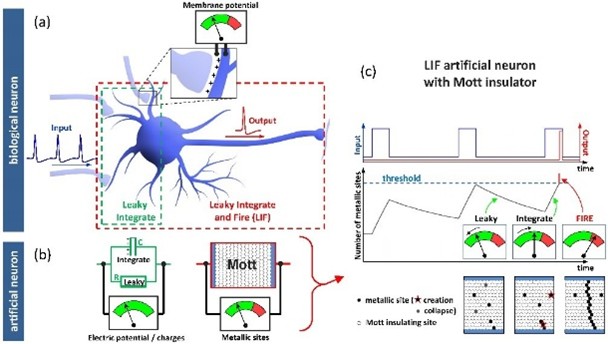
Studied by physicists for several decades for their exceptional physical properties, Mott insulators can become conductors under high pressure or by chemical doping, two parameters difficult to reconcile with the technological constraints of microelectronics. However, pioneering work at IMN has shown that the application of a voltage can make them conductive, paving the way for a new type of electronics known as Mottronics. Our work on several maturation projects (SATT, Pays de la Loire Region, IPCEI) has already led to the production of Mott 1T-1R mott memories integrated on 8′ wafers for information storage (CEA Leti collaboration), or artificial neurons for bioinspired computing.
A major part of our work in the coming years will therefore be aimed at producing energy-efficient “hardware” artificial neural networks based on synapses and Mott neurons.
Key words: Mottronics, Non-volatile memories, Synapses and artificial neurons.
IMN people involved : B. Corraze, M. P. Besland, E. Janod, L. Cario, J. Tranchant