

ANR project
Field-sintered piezo-magnetic composite
Dates:
October 2022 – September 2026
Project coordinator:
Laboratoire des Sciences des Procédés et des Matériaux (LSPM Villetaneuse)
Partner laboratories :
- IMN
- GREMAN University of Tours
- Institute of Analytical Sciences and Physical Chemistry for the Environment and Materials (IPREM Pau)
IMN staff involved:
Philippe MOREAU, Nicolas GAUTIER, Eric GAUTRON
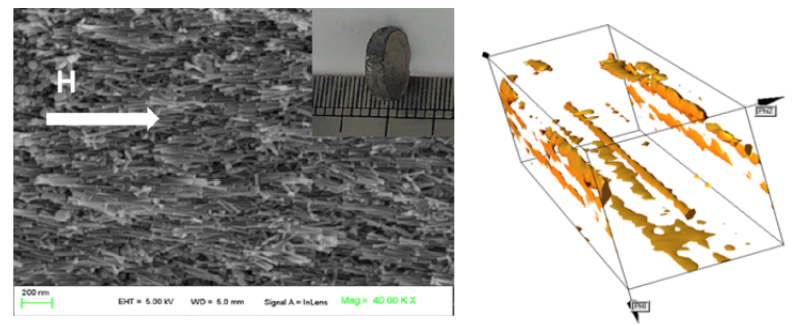
Our project concerns the development of a composite material which, thanks to its innovative chemical composition and structuring, will offer new functions enabling these magnetic characteristics to be modulated by an electric field. The aim is to shape composites whose matrix is made up of an inorganic piezoelectric phase and whose inclusions are based on acicular ferromagnetic nano-objects. The use of lead-free piezoelectric compounds and rare-earth-free magnets will be proactive in relation to current regulations. A new, economical and environmentally-friendly production process will be developed. One of the project’s original features will be to combine Spark Plasma Sintering with the presence of a magnetic field to shape the composites. This sintering process will enable the magnetic phase to be organized within the piezoelectric phase, optimizing its magnetic-electric coupling properties. These properties will be studied in conjunction with the interface micro- and nanostructure.
The main innovative objectives of the COMPAGNON project are :
– The development of an innovative composite with coupled functions for modulating the permanent magnet characteristics (Mr, Ms, Hc and Ka) with an electric field, and with coupling coefficients in the order of hundreds of mV.cm-1.Oe-1.
– Characterization of interfaces in composites using advanced multi-scale techniques: atomic (high-resolution TEM, EELS, etc.), nanostructural (FIB-3D) and composite (XPS, PDF, etc.).
– Contribute to understanding the link between structure-composition-interface within nanocomposites (nanowire-matrix) and the ME properties obtained.
– Overcome fundamental challenges (nucleation and growth of nanowires, development of core@shell systems, magneto-electric coupling, control of grain size, interfaces and densification/structuring of composites……) and technological challenges (field nanostructuring) in the field of multifunctional materials.
– Permanent magnets with a magnetic field of the order of 1 T, without rare earths whose intensity can be controlled by an electric field.