

ANR project
Iodine: Conditioning of this long half-life element in pressurized nuclear glass and glass-ceramics
Dates:
October 2020 – March 2025
Project coordinator:
Laboratoire de Planétologie et Géosciences (LPG Nantes)
Partner laboratories :
- IMN
- Laboratory of subatomic physics and associated technologies (SUBATECH Nantes)
- CEA DES/ISEC/DE2D – French Atomic Energy and Alternative Energies Commission
- Nanosciences and Innovation for Materials, Biomedicine and Energy (NIMBE Gif sur Yvette)
IMN staff involved:
Mickaël PARIS, Philippe DENIARD, Vincent FERNANDEZ, Eric GAUTRON, Stéphane GROLLEAU, Jonathan HAMON, Philippe MOREAU
The radioactive isotope 129I is a by-product of nuclear power plant activity, and is a long-lived intermediate-level waste. Until now, one method of managing 129I used in industrialized countries, including France, has been isotope dilution by discharge into seawater, resulting in a substantial increase in anthropogenic 129I concentrations in the environment. Several alternatives have been considered for immobilizing this radiotoxic isotope, in particular glassy matrices. However, due to its high volatility at high temperatures, the retention rate with this protocol remains very low. As a result, 129I represents an immediate environmental and societal risk until a suitable solution for immobilizing it is defined.
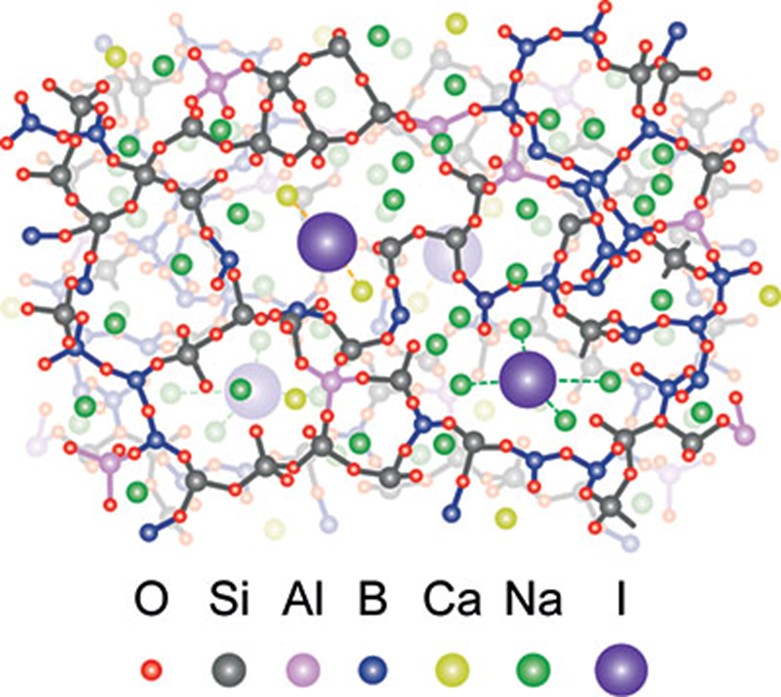
As part of the Iodine-CLEAN-UP project, we are proposing an innovative experimental approach for trapping iodine in glass matrices and glass-ceramics synthesized under high pressure and high temperature. This project is subdivided into three complementary and interconnected tasks. In Task 1, research will focus on determining the solubility laws of iodine in nuclear glass compositions as a function of intensive experimental parameters (pressure, temperature and redox conditions), as well as a function of the chemical composition of the glass matrix. In addition, we will explore the possibility of synthesizing glass-ceramics for iodine immobilization, which has never been studied before. The ultimate aim of this experimental approach is to propose a suitable formulation for long-lasting iodine immobilization in either glass matrices or glass-ceramics, using industrially viable pressure conditions.
The second stage of our project (Task 2) is to determine the mechanisms of iodine dissolution and quantify its effect on the local structure and physical properties of the synthesized materials. This multi-scale approach involves the use of state-of-the-art characterization techniques (NMR, XPS, PDF, TEM and DSC). Our objectives will be to determine, on a microscopic scale, the distribution of iodine within the glass structure and in the crystalline phases (in the case of glass-ceramics), the effect that iodine induces on the silicate and borate network, and the impact of iodine on the glass transition temperature. With these results, we will be able to establish the optimum synthesis conditions and matrix composition for time-stable iodine storage.
Aqueous weathering experiments will be conducted to study the behavior of our iodine-doped matrices under natural environmental conditions and as a function of time. This approach, conducted under aqueous conditions, will require the use of microtechniques to characterize the phases formed during weathering and quantify the elements released into solution. Based on the syntheses carried out, we will determine the initial and residual weathering rates to build a weathering model as a function of time for iodine-doped matrices. We will then be able to establish the feasibility of geological storage of these matrices.
The Iodine-CLEAN-UP project brings together leading French players in the fields of high-pressure experimentation (LPG), materials characterization (IMN), glasses (LPG, IMN, CEA NIMBE) and associated weathering processes (Subatech, CEA DE2D). This multi-disciplinary project covers aspects ranging from materials science to nuclear waste management and environmental considerations. Ultimately, the project could lead to a sustainable industrial solution for immobilizing radioactive iodine produced by nuclear activity.