

ANR project
Luminescent nanocomposites by pulsed injection of colloidal solutions into a plasma
Dates:
October 2021 – March 2025
Project coordinator:
Mireille RICHARD-PLOUET (PCM team)
Partner laboratories :
- Laboratoire de Chimie de Coordination (LCC Toulouse)
- Plasma and Energy Conversion Laboratory (LAPLACE Toulouse)
IMN staff involved:
Nicolas GAUTIER, Antoine GOULLET, Agnès GRANIER, Florian MASSUYEAU, Jean-Yves MEVELLEC, Nicolas STEPHANT
White-light-emitting materials have attracted a great deal of research interest in recent years, due to their potential applications in lighting devices and display media. Although the discovery of strong white light emission from organic-inorganic lead halide hybrid perovskites has recently given new appeal to this research, it remains very intense, and white inorganic phosphors such as zinc oxide continue to be the most studied.
To protect nanocrystalline phosphors and maintain their emission performance, one approach is to embed them in a transparent film of organic or inorganic nature. Among the oxides corresponding to the host matrix characteristic, silica has been identified as a promising candidate thanks to its transparency as well as its chemical stability, biocompatibility and non-toxicity.
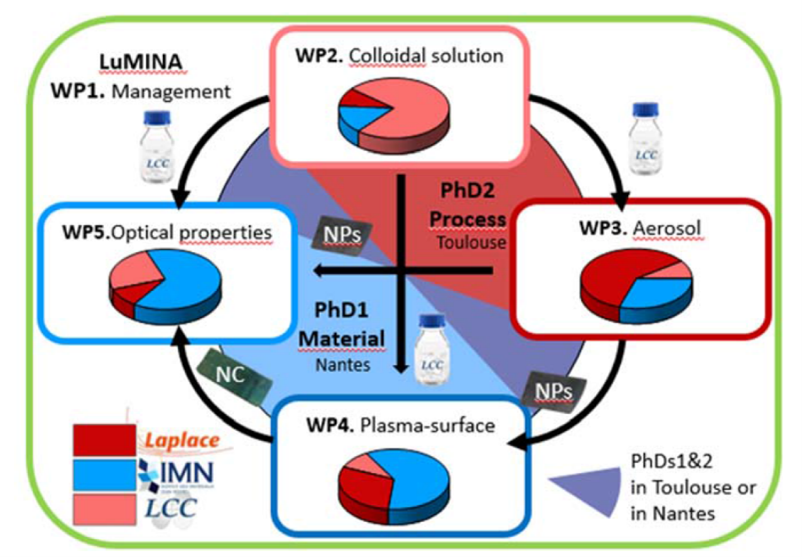
LuMINA aims to synthesize nanocomposite thin films based on optically interesting nanoparticles, embedded in a UV-transparent protective matrix.
Our aim is to prepare photoluminescent nanocomposite thin films based on a stable solution of ligand-stabilized zinc oxide nanoparticles in organic solvents, synthesized in the laboratory.
Prior to characterization, the nanoparticles will be dispersed by injecting the solution into a plasma-enhanced chemical vapor deposition (PECVD) reactor, which enables the synthesis of a silica matrix of high optical quality. Dispersion in the matrix will be monitored and analyzed to assess whether the plasma process affects the photoluminescence of the nanoparticles.