

ANR project
Osteocyte extracellular vesicle content: a new approach to bone tissue regeneration medicine
Dates:
October 2020 – December 2024
Project coordinator:
Regenerative Medicine and Skeleton (RMeS Nantes)
Partner laboratory:
IMN
IMN staff involved:
Jean LE BIDEAU, Patricia ABELLAN, Maxime BAYLE, Nicolas STEPHANT
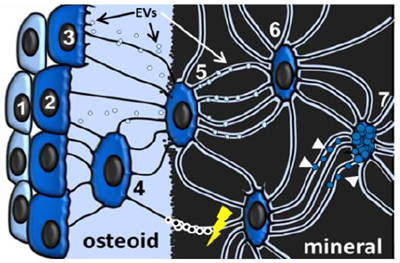
Many clinical situations call for the reconstruction of defects in bone sites. One approach is to restore bone mass by stimulating osteogenesis. OVERbone aims to study a new bone formation mechanism based on the secretion by bone cells of extracellular vesicles (EVs) that can be used for bone tissue regeneration.
Osteocytes, highly specialized cells embedded in the mineralized bone matrix, play an important role in maintaining bone homeostasis and integrity (bone tissue repair), and are intimately linked to the bone aging process. Numerous EVs are present in the bone matrix and are produced throughout life in response to numerous stimuli. EVs contain molecules (proteins, etc.) which are characteristic of their cell of origin and guarantee their functionality. It has been shown in vitro that osteocytes produce EVs, which could constitute a sophisticated intercellular communication mechanism in bone. Thus, the decline in bone tissue renewal and integrity (appearance of micro-fractures) during aging could not only compromise the mechanical properties of bone, but also alter this communication pathway between bone cells.
Our hypotheses are that EVs are released by osteocytes in vivo, that this release constitutes a key event in the dialogue between osteocytes and other bone cells, and that these EVs are essential for osteocyte function in bone. Furthermore, we believe that these EVs are altered during aging, either in quantity or quality, and that this alteration contributes to bone ageing.
The main objective of the OVERbone project will therefore be to establish that these EVs: 1) are present in bone tissue using a nanometric imaging approach, 2) control osteoformation and participate in bone repair, 3) contain molecules responsible for their regenerative properties, which we will attempt to identify, and 4) that these EVs (or molecules they contain) can be used to stimulate bone formation and improve bone regeneration in vivo.
The main novelties of OVERbone lie in the fact that these osteocyte EVs have never been identified as players in physiological bone repair, which is impaired in the elderly patient. In addition, information on the location/environment of EVs in bone tissue, as well as on their ultrastructure observed in situ, will provide a better understanding of communication between bone cells.
During the OVERbone project, EVs will be produced in vivo from the bones of young, adult and aged mice. Two subpopulations of EVs (exosomes (< 100 nm) and microvesicles (up to 1 micron)) will be extracted and characterized. This characterization will consist of biophysical measurements, biochemical analyses to confirm the nature of these EVs, their cellular origin as well as their content, and finally a functional analysis carried out in vitro to assess their effects on the differentiation and activity of osteoforming cells. Quantitative and qualitative changes in EVs isolated from mice of different ages will also be investigated. The challenge of visualizing EVs in bone tissue will be met using new high-resolution electronic imaging techniques. Finally, the osteogenic activity and regenerative properties of these EVs will be demonstrated in vivo in association with biomaterials using tissue engineering approaches.
The success of the OVERbone project relies on the complementary expertise of its partners in the fields of bone tissue pathophysiology, high-resolution imaging, EV purification and characterization, and bone regeneration.