

ANR project
BiBased nanOmaterials for Photocatalysis
Dates:
October 2024 to September 2028
Project coordinator:
Angélique BOUSQUET, Institut de Chimie de Clermont-Ferrand, ICCF
Partner laboratories :
- Institut Pascal-Clermont-Ferrand, ICCF
- Institut Français du Pétrole Energie Nouvelle, IFPEN
IMN staff involved:
Maryline LE GRANVALET, Nicolas GAUTIER, Christophe CARDINAUD, Aurélie GIRARD, Etienne JANOD, Bernard HUMBERT, Jean-Yves MEVELLEC, Franck PETITGAS
Nanomaterials for photocatalysis
Bismuth oxyfluorides are interesting materials for photocatalysis, as the position of their energy bands can be varied by adjusting their chemical composition.
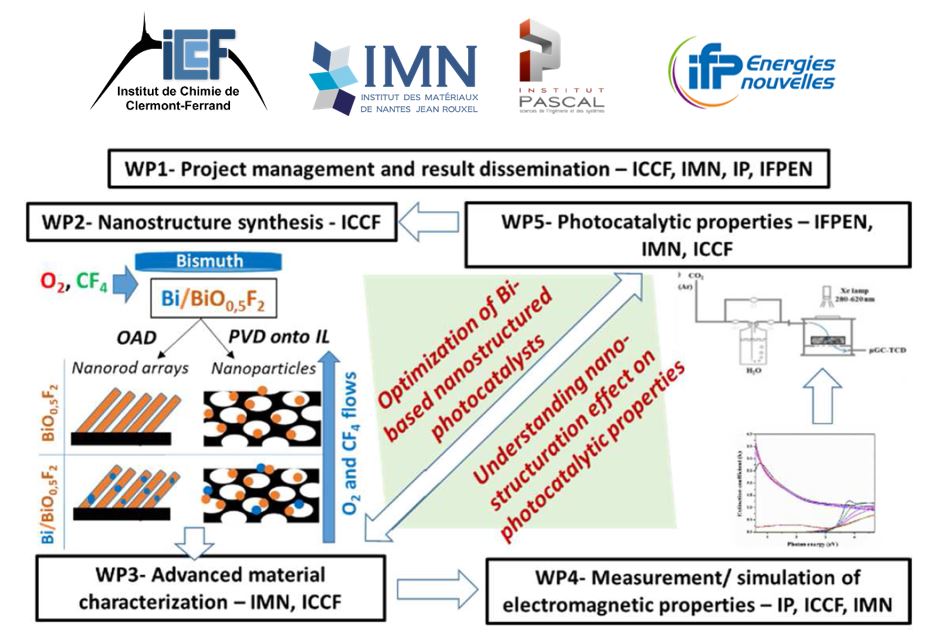
Work carried out at the Institut de Chimie de Clermont Ferrand (ICCF) has shown that this control is possible thanks to reactive sputtering of a Bismuth target in an Ar/O2/CF4 atmosphere. Gas flow management also enables one-step synthesis of Bi/BiOxFy heterojunctions, in which the presence of metal amplifies photocatalytic properties. Initial tests carried out at the Institut Français du Pétrôle Energies Nouvelles (IFPEN) show encouraging CO2 photoconversion and good selectivity for CO, a green fuel. To enhance these performances, the BiBOP project proposes to nano-hierarchize these heterojunctions, either by oblique-incidence sputtering or in an ionic liquid. The effect on CO2 photoconversion properties will then be studied.
The control of this nano-structuring will be entrusted to ICCF, which has expertise in reactive sputtering. The project will also benefit from the materials characterization skills of the Institut des Matériaux de Nantes Jean Rouxel (IMN). It will deploy advanced local analysis techniques, notably with their transmission microscopy apparatus: S/TEM “Nant’Themis”, by developing in situ analyses under stimuli. These experimental data will also be coupled with simulation of the electromagnetic properties of materials, thanks to the expertise of the Institut Pascal (IP).
Finally, the BiBOP project will involve a major French player in catalysis: IFPEN, which will assess the performance of nanostructures for CO2 photo-conversion. IFPEN will bring its expertise in understanding photocatalytic phenomena to bear on optimizing these structures.
Finally, the BiBOP project uses innovative synthesis processes, but above all is part of an approach to developing new functional materials. It will use an approach combining experiment and simulation. The aim of this project is to respond to societal challenges in the field of clean energy production.