

ANR project
Study of Optical Layering and Advanced Research Techniques on Sb₂Se₃ for photovoltaic applications
Dates:
From 01/01/2026 to 31/12/2029
Project coordinator:
Camille LATOUCHE (MIOPS team)
Partner laboratories:
SCR (UMR 6226 CNRS/Univ. Rennes 1, Michel CATHELINAUD
IMN staff involved:
Stéphane JOBIC, Thomas LEPETIT, Jean-Yves NEVELLEC, Jonathan HAMON
Study of Optical Layers and Advanced Research Techniques on Sb2Se3 for Photovoltaic Applications.
This project targets the optimization of Sb₂Se₃ for photovoltaic (PV) applications.
Sb₂Se₃ is a promising material thanks to its high stability, low toxicity and favorable electronic properties.
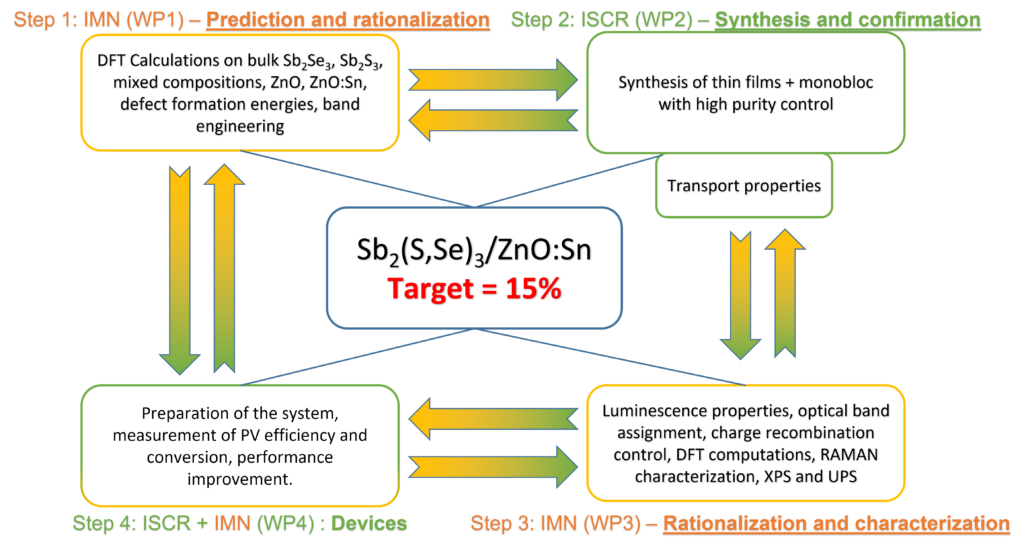
Despite recent advances, the power conversion efficiency (PCE) of Sb₂Se₃-based cells remains below its theoretical limit of 30% hence the need for further research. The main objective of the project is to improve the efficiency of Sb₂Se₃-based PV devices. The focus will be on luminescence properties and defect engineering. Optimization of interfaces with, in particular, Zn₁₋ₓSnₓO (ZTO) as a buffer layer will also be investigated.
First-principles calculations and experimental validation will be combined. They will enable the consortium to simulate and predict luminescence spectra. Defect formation and the modeling of optimal band alignment between Sb₂Se₃ and its buffer layer will thus be explored. These theoretical approaches will guide the synthesis and characterization of high-purity Sb₂Se₃ films. Their doping will improve electronic properties such as charge carrier concentration and mobility. Characterization techniques such as luminescence, Raman spectroscopy and UPS (UV photoelectron spectroscopy) will provide detailed information on material quality and performance. This project therefore aims to develop next-generation solar cells with efficiencies in excess of 15%, reinforcing the potential of Sb₂Se₃ as a sustainable alternative to silicon in the PV industry.