

ANR project
Robust Monolithic Reversible Solid Oxide Cell
Dates:
October 2022 – September 2026
Project coordinator:
SRT Microcéramique Vendôme
Partner laboratories :
- IMN
- Gabriel Lamé Mechanics Laboratory (Lamé Orléans)
- Institute of Condensed Matter Chemistry (ICMCB Bordeaux)
- Ceramics Research Institute (IRCER Limoges)
- ENGIE
IMN staff involved:
Clément Nicollet, Annie Le Gal La Salle
Robust monolithic solid oxide reversible cell
High-temperature electrolysis (SOEC) is a high-potential technology that could position itself as a relevant solution for several medium/long-term markets (2025 – 2030), mainly: (i) large-scale H2 production thanks to its high energy efficiency when external heat is available, (ii) “Power-to-X” by coupling SOEC with chemical reactors to produce several fuels/liquids such as ammonia, methanol and formic acid, (iii) “Power-to-Power” thanks to its ability to operate reversibly between SOEC (electrolysis) and SOFC (fuel cell) modes.
From an industrial point of view, the main aspects to consider are performance, durability, scalability/manufacturability and operational flexibility (temperature, feed gas composition, product gas, etc.). In particular, durability is a critical aspect for most SOEC applications that needs to be considered with great care as it has a direct impact on the economic viability of a major part of the emerging commercial solutions incorporating SOEC technology. To address these aspects, this project named RROC aims to develop and optimize a disruptive SOEC technology based on an industrial-scale cell that will integrate innovative architectures and alternative SOEC materials via scalable and competitive processes. These innovative architectures are also aimed at standardized industrial production based on the expertise of the RROC project partners, while achieving performance and durability levels close to the current state of the art and compatible with commercialization for the three main markets of interest mentioned above.
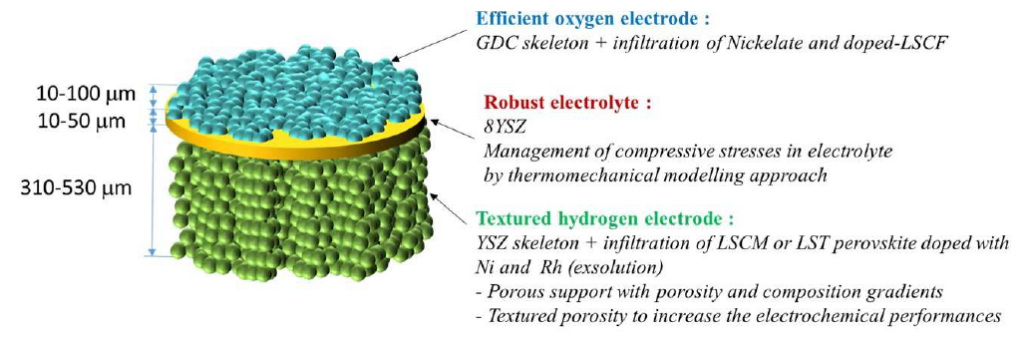
This innovative SOFC/SOEC architecture is based on three original approaches:
– Optimized cell design and material selection based on thermomechanical modeling of systems under operating conditions,
for improved durability
– Monolithic design corresponding to higher thermochemical properties, obtained by co-molding strips,
for improved durability and reduced costs
– Simple shaping process (co-molding or over-molding strips) for cells to limit the number of production steps and production costs,
for low-cost production.