

Project Europe
Exploring innovative tandem solar cell concepts for a sustainable, resilient and inclusive energy future.
Dates:
September 2022 – August 2025
Project coordinator:
Uppsala Universitet (SE)
Partner laboratories:
IMN, Martin Luther Universitat Halle Wittenberg (DE), Université du Luxembourg (LU), Helmholtz-Zentrum Berlin fur Materialen und energie GMBH (DE), InterUniversitair Micro-Electronica Centrum (BE), CNRS (FR), Université de Nantes (FR), Laboratorio Iberico Internacional de Nanotecnologia (PT), Eidgenossische Materialprufungs- und Forschungsanstalt (CH), Zentrum fur Sonnenenergie- und Wasserstoff-Forschung BadenWurttemberg (DE), Sunplugged – Solare Energiesystem GMBH (AT), MEYER Burger (GERMANY) GMBH (DE), Vlaamse Instelling Voor Technilogisch Onderzoek N.V. (BE), Roltec Sp. z o. o. (PL)
IMN staff involved:
Nicolas BARREAU, Ludovic ARZEL, Sylvie HAREL
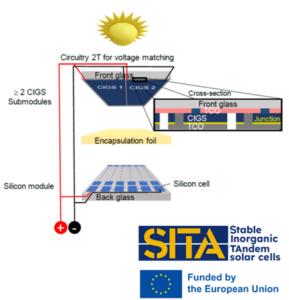
The aim of the SITA project is to study and implement an innovative tandem solar cell concept, using a 2-terminal (2T) approach based on two technologies mastered in Europe: silicon heterojunction cells (SHJ) and Cu(In,Ga)(Se,S)2 wide bandgap cells (CIGS).
The development of this new c-Si/CIGS tandem concept, which requires no additional cables or electronics, is now made possible by recent developments in large-gap CIGS devices, leading to high efficiencies. The SITA consortium will also assess the durability of these modules under realistic outdoor conditions. In this way, SITA will participate in the development of a next generation of stable inorganic tandem solar modules with superior efficiency (>30%).
Tandem cell efficiencies have recently exceeded the Shockley-Queisser limit established for single junctions. SITA will tackle the remaining limits in terms of stability, scale-up, manufacturing costs and environmental impact.
Role of IMN
IMN is involved both in the development of high-efficiency Cu(In,Ga)S2-based cells on transparent substrates, and in the inclusion of these cells in the tandem device. The main scientific challenges relate to the use of transparent substrates and back contacts.