


Overview of the multi-scale modeling approach
Researchers: Rim Ettouri [2023, ->], Ahmed Rhallabi, Christophe Cardinaud, Marie Claude Fernandez, Aurélie Girard, Cédric Mannequin [2022, ->].
Contract researchers: Guillaume Le Dain [2018-2020], Joëlle Zgheib [2021-2023].
Contract engineer: Thomas le Pape [2023-2025],
Doctoral students: Tojo Rasoanarivo [2023-2026], Hamza Tarin [2023-2026], Coline Chartrain [2024-2027].
Doctoral students who have defended: Mickael Cosson (2021), Joëlle Zgheib (2021)
The modeling activity developed within the PCM team aims to :
- Better understand the physico-chemical and electrical phenomena of low-pressure cold plasmas and their interactions with material surfaces
- Provide technologists with simulators capable of predicting the morphological properties of etched patterns or deposited thin films.
- Help optimize plasma processes for depositing and etching materials.
The multi-scale approach developed enables us to predict the spatio-temporal evolution of etched patterns as a function of machine parameters. More recently, modeling activities have been extended to the simulation of the mechanisms involved in a sputtering discharge, with the aim of completing the approach using AI.
Key words: Plasma, etching, pulsed discharge, modeling, energy management
Collaborations: LS2N, IJL, GEM, GEPEA
Applications: Semiconductors, Microelectronics, anti-corrosion
Current or recent research projects: CIFRE (Modeling GaN etching using the ALE Cl2/Ar Atomic Layer Etching process)
Joint thesis with UM6P and IETR: Gas sensor
ED Thesis: Multi-scale plasma modeling in high-power pulse magnetron sputtering (HiPIMS)
Industrial project: Characterization
1 – Multi-scale modeling of plasma etching
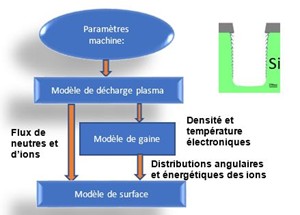
Overall diagram describing multi-scale modeling
Researchers : Rim Ettouri [2023, ->], Ahmed Rhallabi, Christophe Cardinaud, Aurélie Girard, Cédric Mannequin [2022, Isabelle ->]
Post-doctoral fellow : Guillaume Le Dain [2018-2020],
Contract engineer: Thomas le Pape [2023-2025].
Doctoral student : Tojo Rasoanarivo [2023-2026]
The etching of patterns reaching micron or even nanometric sizes is one of the key steps in the manufacture of integrated circuits, as well as in other miniature systems such as sensors or MEMS (Micro Electro Mechanical Systems). To better understand the physico-chemical mechanisms involved in etching, and to optimize the process, we have developed a multi-scale modeling approach to predict the time evolution of etching profiles as a function of machine parameters. This approach comprises three modules:
– a kinetic module to determine the densities and fluxes of neutral and charged species
– a sheath module to calculate the energy and angular distribution functions of ions.
– a surface module to determine the evolution of etched patterns through masks.
This approach has been applied to silicon etching using the Bosch process, and to the etching of III-V materials and steel using chlorinated plasmas. These etching simulators are excellent tools to help technologists develop etching processes.
Key words : Modeling, Etching, Plasma, Silicon, Steel, Bosch, ALE, GAN.
Expertise: Plasma discharge modeling, 2D modeling of plasma etching at mesoscopic and atomic scales, Monte-Carlo approach
Collaborations: Entreprise Semi-conducteurs, IJL Nancy, INSP
Current research projects: STMicroelectronics CIFRE project
Major publications:
Dynamic global model of Cl2/Ar plasmas: Applicability to atomic layer etching processes.
T. Rasoanarivo, C. Mannequin, F. Roqueta, M. Boufnichel and A. Rhallabi.
Journal of Vacuum Science & Technology A 2024, 42, 063003
Study of Cl2/Ar transient plasmas using a dynamic global model.
T. Rasoanarivo, C. Mannequin, F. Roqueta, M. Boufnichel and A. Rhallabi.
Journal of Vacuum Science & Technology A 2025, 43, 033008
Etching of iron and iron-chromium alloys using ICP-RIE chlorine plasma.
G. Le Dain, F. Laourine, S. Guilet, T. Czerwiec, G. Marcos, C. Noel, G. Henrion,C. Cardinaud, A. Girard and A. Rhallabi, Plasma Sources Sci. Technol. 30, 095022 (2021).
2 – Plasma discharge modeling for physical vapor deposition (PVD)
Researchers: Rim Ettouri [2023, ->], Ahmed Rhallabi, Pierre Yves Jouan, Post-doctoral researcher: Joëlle Zgheib [2021-2022]
Doctoral students: Joëlle Zgheib [2018-2021], Coline Chartrain [2024-2027].
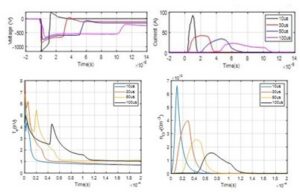
The emergence of the pulsed PVD process known as HiPIMS (High Power Impulse Magnetron Sputtering) has the advantage of improving the structural quality of deposited films. On the other hand, the auto-ionization phenomenon of the sputtered atoms makes the deposit more directional and consequently improves the step coverage of high-aspect-ratio structures (trenches, vias, etc.). These improvements are due to the application of a voltage of a few kilovolts on the cathode, with a duration of a few tens of microseconds and a frequency in the kilohertz range. To better understand the physical phenomena involved in this type of discharge, we are developing a global kinetic model applied to a chromium target bombarded by ions from an argon plasma discharge. The aim of the global model is to quantify the temporal evolution of the densities of neutral species from the gas and the target, as well as charged species. The study of the HiPIMS Ar/Cr discharge could be adapted to other types of gas/target mixtures for other types of thin-film deposition.
To this end, we are developing a global HiPIMS Ar/Ti and Ar/N₂/Ti model in the ionization zone, with a view to the deposition of Ti and TiN thin films. This model will then be extended to the post-discharge in order to quantify the fluxes of active species arriving at the substrate surface.
Key words: Modeling, Simulation, PVD, HiPIMS, Thin films.
Expertise: Plasma discharge modeling, HiPIMS physics, Monte Carlo modeling
Major publications:
A high-power impulse magnetron sputtering global model for argon plasma-chromium target interactions.
Joelle Zgheib, Pierre Yves Jouan and Ahmed Rhallabi.
Journal of Vacuum Science & Technology A 2021, 39, 043004
Modeling of ion transport from ionization region to entrance of mass spectrometer in HiPIMS argon/Cr target
J. Zgheib, P-Y. Jouan, A. Rhallabi, J. Vac. Sci. Technol. A 42, 033004 (2024).