


1 - Advanced materials for solid oxide cells
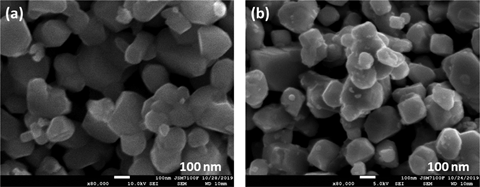
Figure 1. SEM images of (Pr0.5Ba0.5)0.95Mn0.95Ni0.05O3−δ, before and after reduction
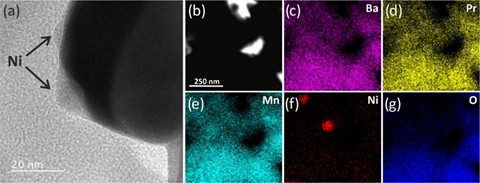
Figure 2. (Pr0.5Ba0.5)0.95Mn0.95Ni0.05O3−δ: (a) HRTEM highlighting two nanoparticles on the oxide support, (b) bright-field image, and (c−g) STEM-EDS elemental mapping images.
Improving efficiency and cell performance requires exploring new materials for electrodes and electrolytes and studying their transport properties (e-, O2-, H+). This research area is organized into three parts:
- For the air electrode, we are studying new materials such as spinel type oxides.
- For the fuel electrode, we are studying the exsolution of metal nanoparticles from sub-stoichiometric perovskite or fluorite type materials.
- For electrolyte, we are characterizing finely proton ceramic conducting oxides and exploring materials with novel crystal structures. More generally, we are studying the links between structure and electrochemical properties.
Aware of the challenges to be faced in developing an environmentally friendly hydrogen sector, our aim is also to reduce the amount of critical or strategic elements entering the composition of the electrolyte or electrodes advanced materials.
Expertises: Material Characterization, X-ray and neutron Diffraction and structural refinement, Solid State Electrochemistry, Impedance Spectroscopy
Keywords: Powder synthesis, materials manufacturing, Cold sintering, metal exsolution, perovskite, solid oxide fuel cell, Electrochemical impedance Spectroscopy
Collaborations :
- International: Julian Dailly (EIFER), Rémi Costa (DLR)…
- France: Pr Anne-Cécile Roger, et Dr Spiros Zafeiratos, Institut de Chimie des procédés pour l’Energie, l’Environnement et la Santé (ICPEES), Strasbourg, Pr Mona Bahout, Institut des Sciences Chimiques, Rennes
IMN Personnel Involved: Clément Nicollet, Eric Quarez, Olivier Joubert, Annie Le Gal La Salle
Key Publications:
- Dingkai Chen, Jinming Zhang, Mathias Barreau, Sylwia Turczyniak-Surdacka, Olivier Joubert, Annie Le Gal La Salle and Spyridon Zafeiratos, Ni-doped CeO2 nanoparticles to promote and restore the performance of Ni/YSZ cathodes for CO2 electroreduction, Appl. Surf. Sci. 611, 2023, 155767
- P. Managutti, S. Tymen, X. Liu, O. Hernandez, C. Prestipino, A. Le Gal La Salle, S. Paul, L. Jalowiecki-duhamel, V. Dorcet, A. Billard, P. Briois et M. Bahout, Exsolution of Ni particles from A-site-deficient layered double perovskites for dry reforming of methane and as an anode material for a solid oxide fuel cell , ACS Appl. Mater. Interfaces 13, 2021, 35719-35728
2 - Influence of oxide surface acidity on O2 reduction
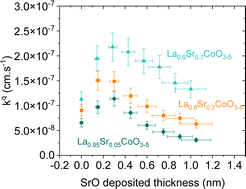
Improving the kinetics of O2 reduction on oxide surfaces is critical in many energy and fuel conversion technologies. By changing the morphology of the samples, but also by infiltrating binary oxides from strongly basic (Li2O) to strongly acidic (SiO2) onto the surface of Pr0.1Ce0.9O2-δ samples, it is possible to vary drastically the reaction kinetics. Our aim is to use these properties to increase cells performance, but also increase their robustness towards pollutants and ageing. In order to be sure of our conclusions, we are also focusing on the accurate determination of the oxygen exchange reaction rates.
Expertises: Material Characterization, Solid State Electrochemistry, X-ray Diffraction, Impedance Spectroscopy
Keywords: Fuel Cells Oxygen Surface Exchange Kinetics, Electrochemical impedance Spectroscopy, Electrochemical Relaxation
Collaborations: Pr Harry Tuller, Massachusetts Institute of Technology. US, Juergen Fleig
France: Jacinthe Gamon (ICMCB)
IMN Personnel Involved: Clément Nicollet, Olivier Joubert
Key publications:
- Alexandre Merieau, Matthäus Siebenhofer, Christin Böhme, Markus Kubicek, Olivier Joubert, Juergen Fleig and Clement Nicollet. Oxygen surface exchange kinetics of La1−xSrxCoO3–δ thin-films decorated with binary oxides: links between acidity, strontium doping, and reaction kinetics, J. Mater. Chem. A 12, 2024, 13960-13969
- Clement Nicollet, Clément Meyssonnier, Simon Guillonneau, Alexandre Merieau and Insaf Abdouli, A New Method to Measure Oxygen Surface Exchange Kinetics On Porous Mixed Conducting Oxides With Simple Determination of Microstructure Parameters, Small Methods 2024, 2400131
3 - Shaping of ceramics for cell manufacturing

SEM images are obtained on non-calcined samples directly sintered at 1400 °C for 10 h, cross-sectioned, polished, cleaned with ethanol, and with a thermally etched at 1350 °C for 3 h: a) BaZr0.4Ce0.4Y0.1Yb0.1O3-δ reference pellet, b) BaZr0.4Ce0.4Y0.1Yb0.1O3-δ + 0.5 wt% ZnO, c) BaZr0.4Ce0.4Y0.05Yb0.1Zn0.05O3-δ, d) BaZr0.4Ce0.4Y0.075Yb0.075Zn0.05O3-δ, highlighting the impact of doping and sintering strategies on porosity and grain morphology
Having promising materials is not a sufficient condition to be able to prepare efficient cells. The shaping of these materials to make cells can have significant impacts on the efficiency of systems. Our team focuses on different aspects of shaping materials for cell manufacturing:
- The use of «Cold Sintering» or « sintering aids » to reduce the high sintering temperatures necessary for electrolyte densification
- The use of tape-casting and screen-printing to optimize electrolyte electrodes interfaces
- The preparation of porous / dense / porous architectures built first by tape-casting the support, then adding different thin and dense or porous layers mainly using screen-printing or PVD.
- The implementation of cell recycling and the manufacturing of new cells from recycled materials
Expertises: Sol-gel synthesis, Self combustion, Solid state Synthesis, X-ray diffraction, microscopy, Cold sintering, screen printing, Electrochemistry
Keywords: Synthesis, ceramic manufacturing, Densification, Sintering aids, Proton-conducting electrolytes, Conductivity, Electrochemical impedance Spectroscopy
Collaborations:
- International: Rémi Costa, Group Leader, German Aerospace Center (DLR), Stuttgart, Germany, Julian Dailly, Senior project manager, European Institute for Energy Research, (EIFER) Karlsruhe, Germany
- France: Pr Gilles Taillades, Institut Charles Gerhardt, Montpellier
IMN Personnel Involved: Olivier Joubert, Annie Le Gal La Salle, Clément Nicollet, Eric Quarez
Key Publications:
- Lozane Hamze, Annie Le Gal La Salle, Olivier Joubert and Eric Quarez, Impact of sintering procedures on the densification and conductivity of BaZr0.4Ce0.4Y0.1Yb0.1O3-δ electrolyte for protonic ceramic fuel cells, Int. J. Hydrogen Energy 139, 2025, 316-324
- P. Castellani, E. Quarez, C. Nicollet, O. Joubert, N. Gautier, P. Pers, G. Taillades and A. Le Gal La Salle, Cold-sintering and Li doped ZnO sintering aid for the densification of BaZr0.7Ce0.2Y0.1O3-δ proton conducting ceramics, Int. J. Hydrogen Energy 54, 2024, 1343-1356
4 - Enlargement of operating conditions of fuel cells: electrode poisoning, marinization, alternative fuels: syngas, ammonia, biomass
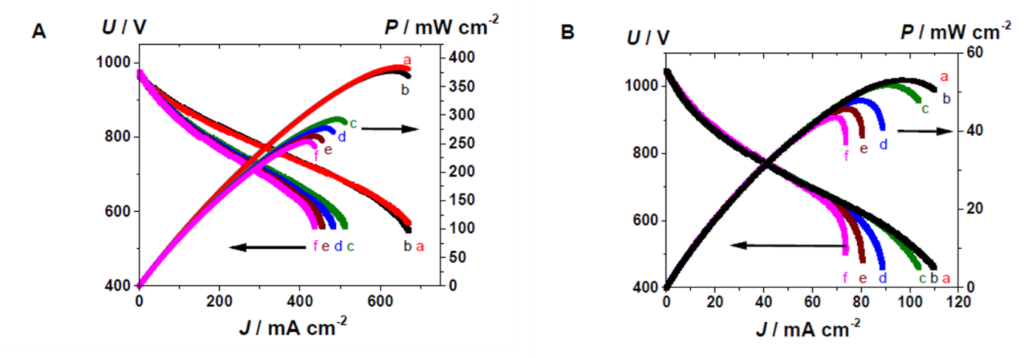
Voltage and power density versus current density characteristics of the cell 107.10 recorded at 10 mV s-1 under air on the cathode side and (A) wet (3% H2O) 15% H2-15%CO-10%CO2-50%N2 mixture on the anode side at 850 °C (A) and 600 °C (B) containing H2S concentrations of 0 ppm (a), 1 ppm (b), 2 ppm (c), 3 ppm (d), 4 ppm (e) and 5 ppm (f).
High-temperature fuel cells with ceramic membrane (SOC: Solid Oxide Cell) with anionic or protonic conduction, although less mature, allow the use of various fuels, and can operate in reversible mode alternating the functions of electrolyser and generator. The aim of the different projects is to develop cells working with various gaseous mixtures, while presenting good tolerance to catalysts poisons commonly encountered in these systems (CO, soot, H2S), and also with ammonia. The influence of pollutants present in air, such NaCl in marine environments, is another topic developed in the group. The synthesis of green H2 from NH3 decomposition, which is of high interest due to Hydrogen storage concerns, is also studied.
Expertise: Material Characterization, X-ray Diffraction, Solid State Electrochemistry, Impedance Spectroscopy
Keywords: Solid oxide fuel cell (SOFC), Biomass, Gaseous mixtures, Catalysis, Dry reforming, Wet reforming, lanthanum strontium cobalt ferrite (LSCF), sodium chloride (NaCl), marine environment, long-term degradation, electrochemical impedance spectroscopy (EIS)
Collaborations:
- International: Rémi Costa (DLR), Julian Dailly (EIFER)
- France: Dr Marie Lamard, CEA Tech, Nantes, Pr Albert Subrenat, Laboratoire GEnie des Procédés Environnement – Agroalimentaire, IMT-Atlantique Nantes
IMN Personnel Involved: Clément Nicollet, Olivier Joubert, Annie Le Gal La Salle
Key Publications:
- F. Ricoul, A. Subrenat, O. Joubert et A. Le Gal La Salle, Electricity production from lignocellulosic biomass by direct coupling of a gasifier and a Nickel/Yttria-stabilized Zirconia-based solid oxide fuel cell: Influence of the H2S content of the syngas onto performances and ageing, J. Solid St. Electrochem, 22, 2018, 2789-800
- E. Pichot, M. Olivon, A. Perraud, O. Joubert et A. Le Gal La Salle, Electrochemical study of the versatility of a solid cell working both as fuel cell and electrolysis modes, Fuel Cells, 20, 2020, 332-341
5 - Solid oxide cells recycling
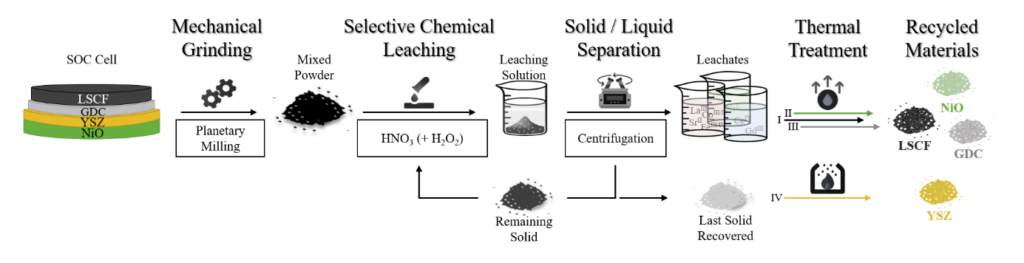
Figure- Schematic representation of a protocol allowing the recovery of constituents of an elementary SOC cell
Solid oxide cells (SOCs) are composed of two porous electrodes separated by a dense pure ion conducting electrolyte. The fuel electrode is generally a composite made of an oxide ion conductor such as YSZ (Yttria-Stabilized Zirconia), or GDC (Gadolinium-Doped Ceria) and an electron conducting metal such as nickel. On the air side, the electrode is usually a mixed ionic and electronic conductor, such as Strontium-Lanthanum-Cobalt-Iron oxide perovskite type phase. An important issue of the life cycle assessment of SOC cells is the use of critical elements, such as Ni, Co, La , Sr, Ce, Gd, Zr, and Y. If one effective approach to reduce environmental impacts would be to reduce critical materials use, anther one is to recycle them. For a few years, we have therefore undertaken to develop recycling protocols, which we are gradually improving both to improve the purity of recycled materials, but also to reduce the environmental impact of the recycling process.
Expertises: Analytical chemistry, hydrometallurgy, Characterization methods (X-ray diffraction, SEM, EDS, ICP, Granulometry)
Keywords : SOC recycling, Circular economy, Solid oxide cells, End-of-life product, Recycling, Hydrometallurgy, Selective Leaching, Critical raw materials, Strategical raw materials
Collaborations:
- International: Pr Anke Weidenkaff, Technical University of Darmstadt, Deutschland; Dr Vesna Middelkoop. VITO (Vlaamse Instelling voor Technologisch Onderzoek), Belgium.
- France: Pr Rose-Noëlle Vannier, Unité de catalyse et de chimie du solide de l’Université de Lille, Dr Patrice Tochon, Directeur recherche et Stratégie, Genvia.
IMN Personnel Involved: Olivier Joubert, Annie Le Gal La Salle
Key Publications:
- Valentin Brard, Olivier Joubert, Annie Le Gal La Salle, Development of multi-step acid/oxidant-based process for recovery of Solid Oxide cells components, Int. J. Hydrogen energy, accepted
- Gudaysew Tsegaye Yenesew, Clement Nicollet, Eric Quarez, Annie Le Gal La Salle and Olivier Joubert, Scalable recycling and characterization of end-of-life solid oxide cell ceramic component materials., Next Sustainability 6, 2025, 100110
Sous-thématiques
- 1 – Advanced materials for solid oxide cells
- 2 – Influence of oxide surface acidity on O2 reduction
- 3 – Shaping of ceramics for cell manufacturing
- 4 – Enlargement of operating conditions of fuel cells: electrode poisoning, marinization, alternative fuels: syngas, ammonia, biomass
- 5 – Solid oxide cells recycling