

ANR project
Inorganic thin-film photovoltaic devices for a sustainable power supply for the Internet of Things
Dates:
January 2024 – June 2027
Project coordinator:
Thomas LEPETIT (MIOPS team)
Partner laboratory:
IMN
IMN staff involved:
Nicolas BARREAU
In 2021, 12.2 billion Internet of Things (IoT) devices were already connected, and forecasts predict 20 billion by 2025. Of these connected devices, most are wireless, operate indoors and are powered by a primary battery that typically lasts between 8 and 25 months. The rate of proliferation of IoT devices is so high that in a few years’ time, hundreds of millions of IoT batteries may have to be replaced every day, implying high maintenance costs, not to mention battery production and recycling or disposal. Recent developments in low-energy electronics and wireless communication protocols have dramatically reduced the energy and power demands of IoT devices, and opened up new prospects for powering them by harvesting energy from ambient light inside buildings.
Indoor photovoltaic devices based on organic or hybrid absorbers have achieved significant power conversion efficiencies (PCE), and numerous materials have been tested in recent years. However, these still suffer from stability problems that limit their commercial acceptability. The main conclusion of a recent review on the subject is that “an inorganic solar cell that retains more than 80% of its initial PCE value even after 10 years of manufacture needs to be developed to compete with the energy sources currently used in IoT devices”.
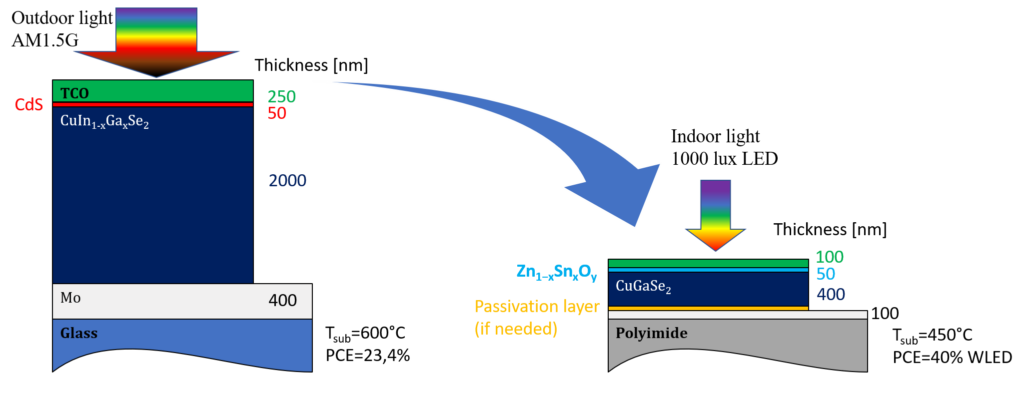
The aim of the project is to generate energy for IoT devices from ambient artificial light using flexible thin-film solar cells based on a stable inorganic CuGaSe2 semiconductor (CGS) with a chalcopyrite structure . These devices have the potential to convert up to 50% of the indoor artificial light spectrum, as the absorber’s 1.7 eV bandgap allows absorption of all photons above 1.8 eV in the LED spectrum without excessive thermalization losses. The synthesis of homogeneous, single-phase CGS thin films is a challenge, particularly at low temperatures, which is necessary for deposition on flexible substrates. As CGS growth is limited by slow formation kinetics, high-yield devices are usually obtained using long relaxation steps at high substrate temperature. We have recently demonstrated that metal halides can be used to significantly reduce the synthesis temperature of CIGS films, as well as to produce single-phase CGS thin films with large grains. This novel and unique approach of using metal halides as a transport agent to promote grain growth therefore has all the ingredients to break through the technological barriers that, to date, restrict the use of stable and industrially compatible CGS compounds for indoor photovoltaic applications on flexible substrates. The project will also focus on the use of heavy alkaline treatments to improve the quality of the junction based on this absorber. Finally, material consumption will be optimized by reducing the thickness of the layers making up the cell stack, and the toxic CdS buffer layer will be replaced by an alternative buffer layer based on non-toxic and abundant materials.