

ANR project
Bosch Optimised Reactive Etching using Artificial InteLligence for cryogenic applications
Dates:
Marsh 1st 2027 – February 28th 2031
IMN coordinator of the project:
Rim ETTOURI (Assistant Professor), PCM team
Persons of IMN involved:
Ahmed RHALLABI (PR UNIV), Aurélie GIRARD (MC UNIV), Ph.D. student (to be announced), Master’s student (to be announced)
Bosch Optimised Reactive Etching using Artificial InteLligence for cryogenic applications
BOREAL aims to improve the understanding and control of deep silicon plasma etching at cryogenic temperature (below -100°C).
The fabrication of three-dimensional microsystems, sensors and electronic components often requires deep and narrow structures to be etched into silicon. However, the processes used to produce these structures remain complex to control: small variations in operating conditions can affect the etch rate or generate defects, such as irregular sidewalls.
Operating at cryogenic temperature can produce smoother and better-controlled etch profiles, but plasma-surface interactions then become particularly important. BOREAL will combine experiments, physics-based simulations and artificial intelligence methods to better understand these phenomena and predict their effects.
The project will investigate the entire process, from the formation of reactive species in the plasma to their transport towards the silicon and their interactions with its surface. The resulting structures will be characterized to analyse their shape, depth and sidewall quality. Particular attention will also be paid to the thin protective layers that temporarily form on the sidewalls during the process and play a key role in controlling the etching.
Results from simulations and experiments will then be used to train artificial intelligence models. These models will make it possible to rapidly estimate the influence of the main process parameters, such as pressure, applied powers, gas composition and the duration of the different process steps.
The final objective of BOREAL is to develop a digital twin demonstrator of the process. This virtual representation will link the machine operating parameters to the expected results, such as etch rate and depth, the shape of the etched structures and the quality of their sidewalls.
This tool will help researchers and engineers identify the most suitable processing conditions more quickly, while reducing the number of time-consuming and costly experimental trials.
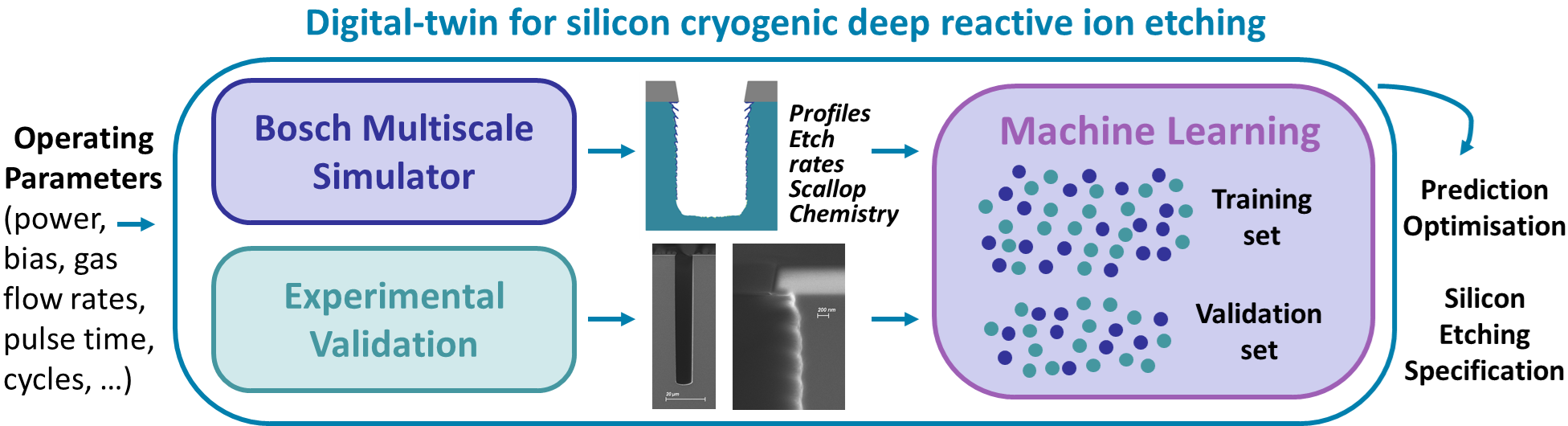
Figure: Principle of the digital twin developed in BOREAL: combining multiscale simulations, experimental data and artificial intelligence to predict and optimize cryogenic deep silicon etching.