

ANR project
Advanced Dielectric Nanocomposite thin films processed by hybrid aerosol / low pressure plasma for microelectronic capacitor applications
Dates:
March 2025 – Sept 2029
Project coordinator:
LAPLACE, Toulouse
Partner laboratories:
IMN staff involved:
Antoine GOULLET, Marie_Paule BESLAND, Mireille RICHARD, Nicolas GAUTIER, Nicolas STEFFANT, Franck PETITGAS
Advanced dielectric nanocomposite thin films treated with hybrid aerosol/pressure plasma for microelectronic capacitor applications
Metal-insulator-metal (MIM) capabilities involve the development of new 2D or 3D nanostructured materials. The main challenge is to increase dielectric permeability and the breakdown field, while keeping leakage current low.
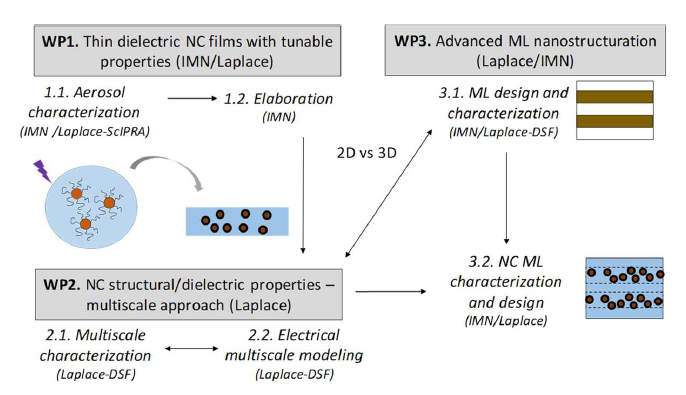
In this context, the ADN project aims to design and develop nanostructured thin films (nanocomposites and multilayers) based on TiO2 and SiO2. They will increase dielectric permeability while maintaining low leakage currents. To achieve this, we’ll be using an innovative manufacturing process based on a low-pressure plasma-hydride process coupling the injection of colloidal solutions of TiO2 nanoparticles and the deposition of the SiO2 layer by Plasma Enhanced Chemical Vapor Deposition (PECVD).
To optimize this process, we need to understand the plasma/aerosol interaction leading to the formation of the nanocomposite layer. In parallel, we will study the electrical properties of these layers, and more specifically the influence of nanostructuring of the nanocomposite material (concentration and dispersion of nanoparticles, interfaces, etc.) on the dielectric properties. To this end, nanocomposite and/or multilayer structures will be modeled and characterized at macroscopic and nanometric scales using techniques derived from atomic force microscopy (AFM).
The best-performing nanocomposite thin films in terms of high dielectric permeability and low leakage current will be identified. Finally, thanks to the information extracted from the electrical characterization of the stacks and nanocomposite materials, as well as from the modeling results, we will propose an innovative multilayer architecture made up of alternating layers of SiO2 and nanocomposites. This new system will be developed and evaluated.