


ANR project
Unveiling Lithium Dynamics in Silicon Electrodes after Pre-lithiation through Correlative AnaLyses, IisotopeTracing, and MModeling
Evaluation of Lithium Dynamics in Silicon Electrodes After Pre-Lithiation Using Correlative Analyses, Isotope Labeling, and Modeling
From April 1, 2027, to September 30, 2030
Project Coordinator: Nicolas DUPRE,ST2Eteam
Partners:
CEA-LITEN
CEA-ISAS
Luxembourg Institute of Science and Technology (LIST)
E-Magy (Netherlands)
IMN staff involved: Nicolas DUPRE (CNRS Researcher), Bernard LESTRIEZ (University Professor), Michael PARIS (University Researcher), Patrick Soudan (CNRS Researcher)
Evaluation of Lithium Dynamics in Silicon Electrodes After Pre-Lithiation Using Correlative Analyses, Isotope Labeling, and Modeling
CALISToM aims to build on the advances made in a previous ANR project from 2022–2025 called NanoLiT. This new project will focus on advancing the state of the art in the study of lithium mobility. To address key questions that remained unexplored during the first project, we will employ a unique methodology based on advanced microscopy as well as NMR. High-resolution SIMS and lithium isotope tracing will also be utilized. The results obtained will provide an unprecedented understanding of lithium dynamics within the active material, as well as at the electrode-electrolyte interface (SEI) of next-generation nanostructured silicon electrodes. This approach will position our consortium at the forefront of this rapidly evolving field of research. We will also determine the impact of pre-lithiation on the evolution of lithium transport properties within the SEI.
Combining modeling with experimental data will make it possible to determine the contribution of silicon nanostructuring. It will provide insight into how cycling conditions affect the behavior and electrochemical properties of the SEI.The impact of electrolyte additives and the use of liquid ionic electrolytes will also be studied and compared to conventional carbonate electrolytes.An examination of the trapping effects and pathways of lithium ions in the SEI and/or in the active material will lead to an in-depth description of the mechanisms involved in the failure scenario of silicon-based electrodes. The objectives are to gain a detailed understanding of the transport properties between the electrodes and the electrolyte in order to better control these phenomena and further optimize the design of next-generation electrodes.
In addition, the CALISToM project will implement and refine innovative correlative characterization methodologies. These procedures will advance our understanding of pre-lithiation and diffusion mechanisms. These methods can be applied to numerous other topics in the field of batteries in general.
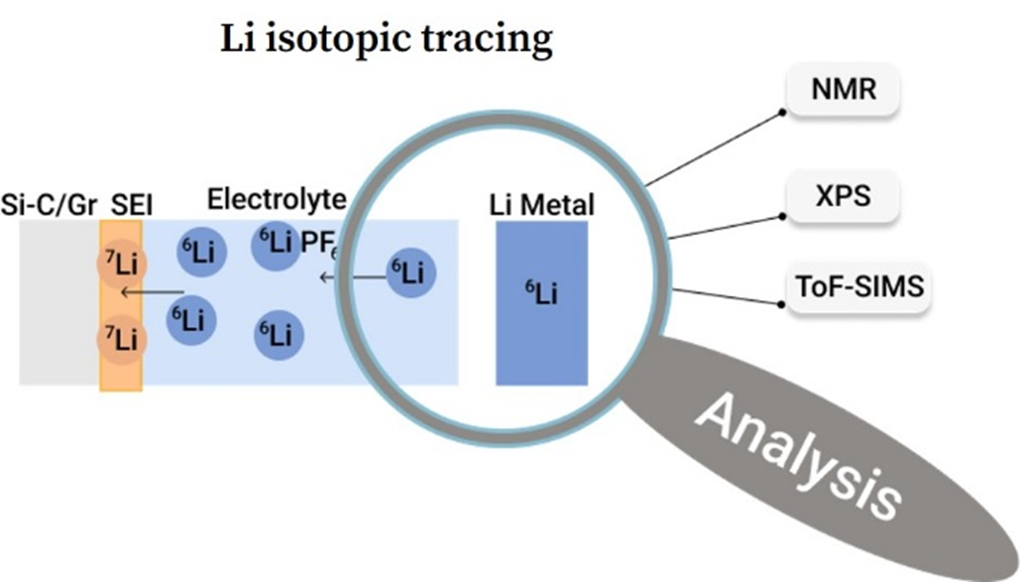
Caption:CALISToM aims to conduct an in-depth study of the trapping effects and migration pathways of lithium ions in the SEI and/or in the active material using 6Li/7Li to provide a detailed description of the mechanisms involved in the failure scenario of silicon-based electrodes.