

Regional Project
Solar Energy ConversionforH₂ Production and the Recovery ofDairyEffluentsUsing Photo(Electro)catalyticArchitectures
Dates:
From May 1, 2026, to April 31, 2029
Project Coordinator:
Clément MAHEU (IMN, MIOPS-PCM)
Partner laboratories:
- Jean Rouxel Institut des Matériaux de Nantes (IMN) (CNRS-University of Nantes) (UMR 6502)
- Interact Research Unit (UniLaSalle) (UP 2018-C102)
- Chemistry and Interdisciplinary Research Laboratory: Synthesis, Analysis, and Modeling (CEISAM) (CNRS-Nantes University) (UMR 6230)
- Environmental and Agri-Food Process Engineering Laboratory (GEPEA) (CNRS-Nantes University-IMT Atlantique-Oniris)
IMN staff involved:
, Maria Teresa CALDES, Houria KABBOUR, Stéphane JOBIC, Nicolas BARREAU, Ismail YUSUF, Axel AUBIN, Léo CHOUBRAC
Solar Energy Conversion for H₂ Production and the Recovery of Dairy Effluents Using Photo(Electro)catalytic Architectures
The CH2EESE project, co-funded by the CNRS and the Pays de la Loire region, offers an innovative solution to address the challenges of the ecological transitions in the Pays de la Loire region: the conversion of dairy and cheese effluents into green hydrogen and high-value-added molecules through solar-powered photo(electro)catalytic processes. This process makes it possible to produce hydrogen locally, to convert waste into valuable molecules—thereby providing farmers with additional income—and to treat these effluents to remove pollutants.
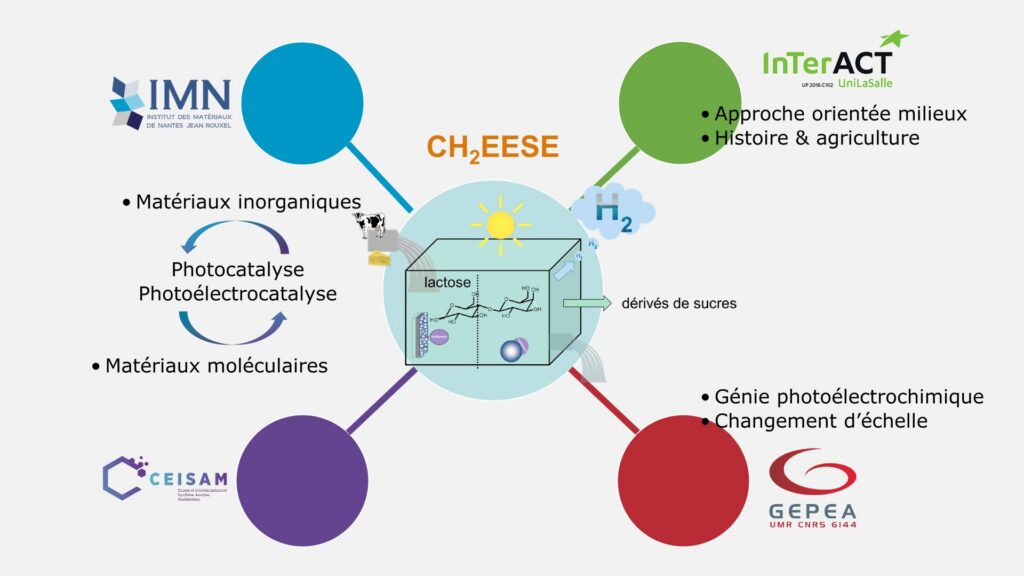
While the technology for the photoconversion of sugar-rich effluents and the materials involved are already innovative, this project also stands out for its interdisciplinary nature. The project is based on an integrated approach combining materials physics and chemistry, process engineering, and the humanities and social sciences, and is brought to life through the synergy of four laboratories: IMN, CEISAM, GEPEA, and InTerACT.
The inorganic materials developed at IMN (chalcogenides, mixed anions, oxides) will serve as photo(electro)catalysts enhanced by innovative molecular co-catalysts synthesized and grafted at CEISAM. These co-catalysts will enable the conversion of sugars and the selective production of molecules with the highest added value. These organic-inorganic hybrid materials will be tested for the recovery of dairy effluents and hydrogen production. Physicochemical characterizations will be conducted to establish structure-activity relationships and optimize the materials over the course of the three-year project.
GEPEA’s expertise will make it possible to take into account the process-related aspects of the system, study the various laboratory reactors used within the consortium, develop an initial prototype, and—using modeling—estimate its performance at a farm-scale level. Finally, the InTerACT unit, composed of historians, sociologists, and philosophers, will guide the consortium in implementing a new “environment-oriented” approach to technical design. This approach involves, among other things, attaching equal importance to the system, the stakeholders involved, the ecosystem in which the system operates, and the interactions between these three entities. Thanks to these two approaches—process-oriented and technical design—we can ensure, prior to the system’s deployment phase, its performance and its benefits for the environment.
This project aligns with the priorities of the Pays de la Loire Region: climate change, the “Hydrogen Planet” initiative, the ecological status of water bodies, and support for the dairy and cheese industry. It was therefore funded by the region to the tune of 568.4 k€ as part of its “academic research demonstrator” call for proposals.