

NextEnergy
What if a material’s history mattered more than its composition!
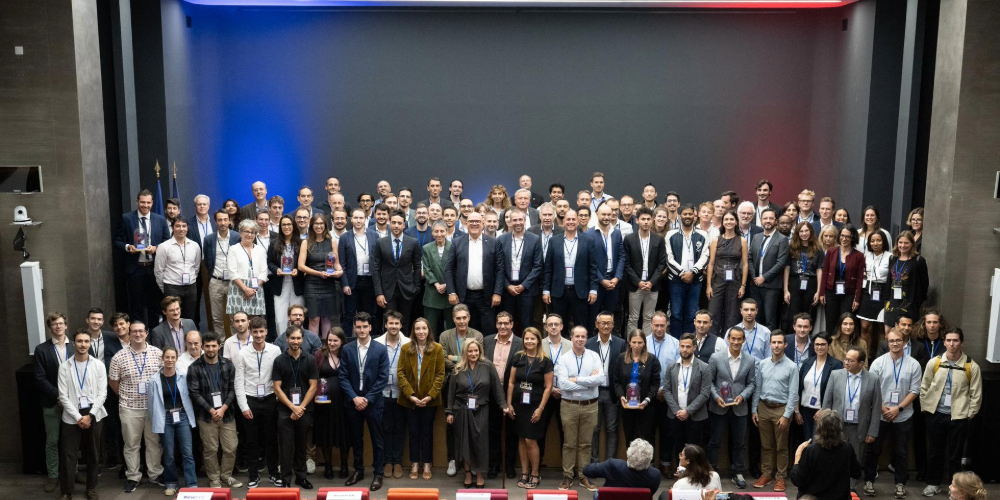
A joint publication by the ISCR-Institut des Sciences Chimiques de Rennes, the IMN, and the ILL —the Institut Laue Langevin—and the Catalysis and Solid-State Chemistry Unit (UCCS) has been honored by the French Society for Neutron Science (SFN) and the French Federation for Neutron Scattering (2FDN).
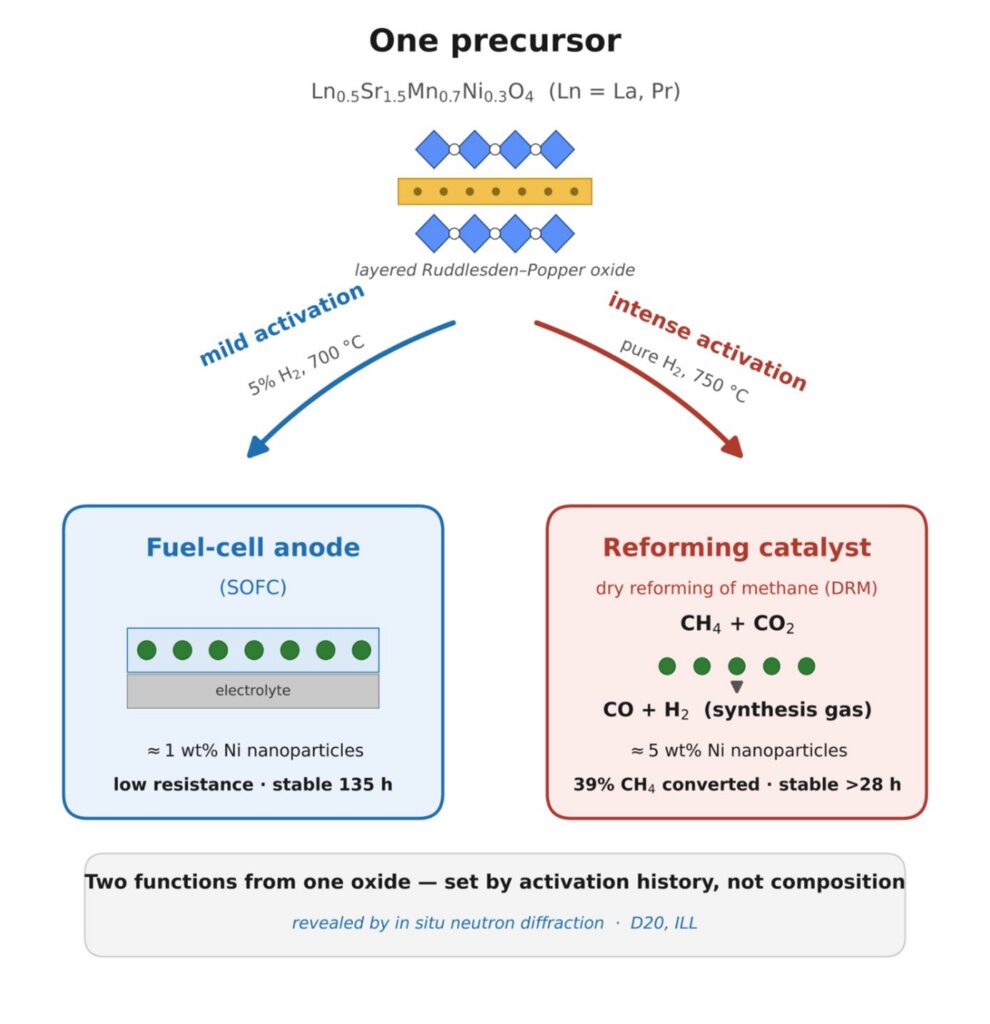
Materials used for clean energy production are almost always designed to be stable. This study turns that logic on its head: by deliberately controlling how an oxide is reduced—its “activation history”—the same starting material can be adapted for two completely different functions without changing its chemical composition. The authors call this “activation engineering.”
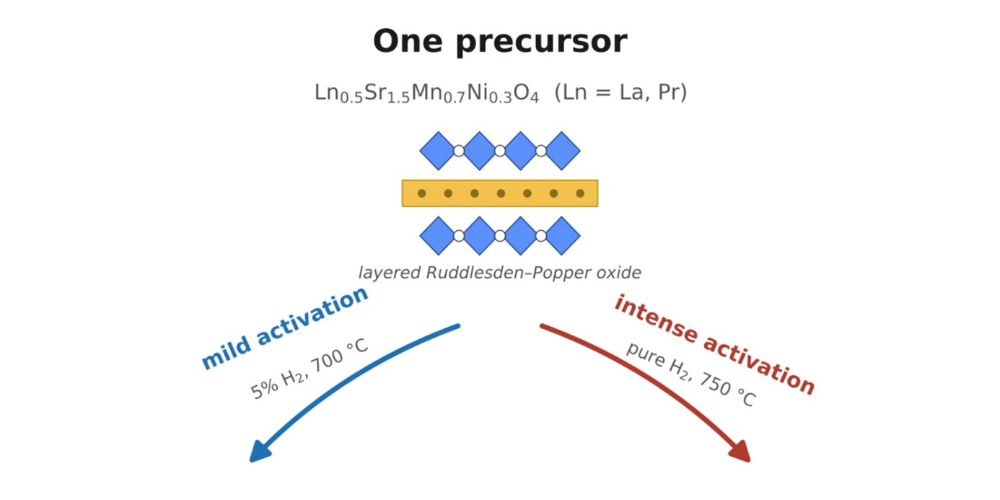
Using in situ neutron diffraction (D20, ILL), the authors analyze the behavior of a strontium-rich Ruddlesden–Popper-type lamellar oxide with the composition Ln₀,₅Sr₁,₅Mn₀,₇Ni₀,₃O₄ (Ln = La or Pr):
– moderate reduction causes the exsolution of approximately 1 mass % of metallic nickel and yields an excellent fuel cell anode (a specific resistance of 0.74 Ω·cm² at 700 °C, the best value ever reported for this family of oxides);
– More intense reduction leads to the exsolution of approximately 5% by mass of Ni and instead produces a robust catalyst for dry methane reforming, converting the greenhouse gases CH₄ and CO₂ into useful synthesis gas for more than 28 hours.
By tracking oxygen—which is difficult to see with X-rays—in real time, neutrons turn this “activation engineering” into a predictable design tool.
Congratulations to the authors:
– Mona Bahout, faculty member and researcher at ISCR
– Thi Thuy Duyen Nguyen, doctoral student at IMN
– Elodie Quénard, design engineer at ISCR
– Thomas Hansen, researcher at ILL
– Vincent Dorcet, CNRS research engineer at ISCR
– Marcia Araque Marín, lecturer and researcher at UCCS
– Serge Paofai, design engineer at ISCR
– Noée Dumait, assistant engineer at ISCR
– Annie Le Gal La Salle, CNRS research director at IMN, ST2E team
– Olivier Joubert, professor at the University of Nantes at the IMN, ST2E team
Read about this highlight in the September 2026 issue of the SFN-2FDN newsletter:
– French
– English
You can view the article published in Next Energy on ScienceDirect.
Share this article
Other articles