

A New ANR Project for the IMN: PRC H-Carbocage
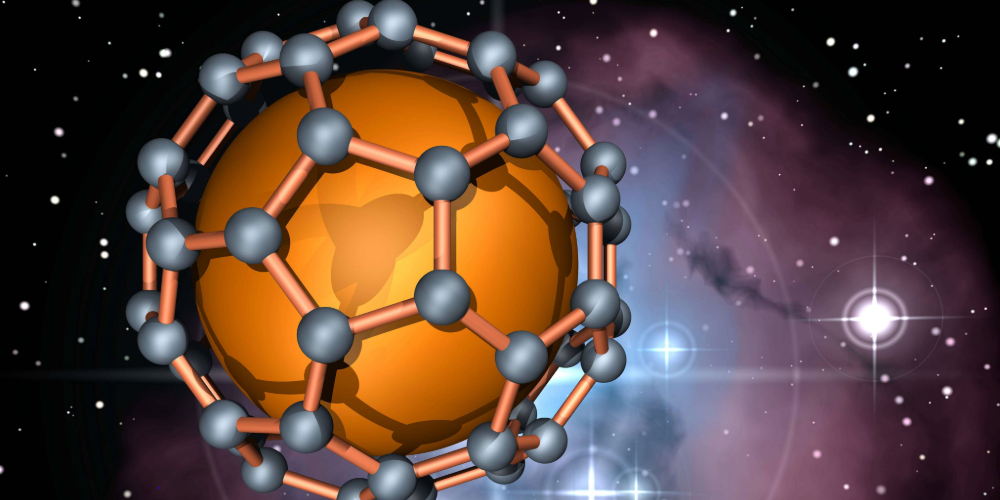
Chris Ewels, a CNRS researcher onthe PMN team, has just received funding fromthe ANR for his PRC H-Carbocage research project: “Small hydrogenated fullerenes: from the laboratory to astrophysical environments.”
H-CARBOCAGE is a 54-month research project that seeks to solve a long-standing mystery in astrophysics.
This project brings together three French research institutes: the IMN, the ISMO, and the IAS.
International partners from Scotland (Edinburgh) and Western Ontario, Canada, are also joining this project. Fullerene C60—the famous soccer-ball-shaped carbon molecule whose discovery earned its discoverers the Nobel Prize—has been detected in space. However, an entire family of smaller “cousins”—potentially stabilized by a small amount of hydrogen—has never been observed or even thoroughly studied in the laboratory.
These hydrogenated carbon cages, or “fullerenes,” may help explain two of the most enigmatic and unidentified light signatures observed throughout the galaxy. Mysterious infrared emissions, as well as an ultraviolet “bump” first detected more than sixty years ago, have been observed.
Combining current computer modeling, laboratory experiments, and data from the James Webb Space Telescope could make it possible to identify these previously unidentified molecules. The results obtained would thus shed light on the role hydrogen plays in the formation of some of the most fundamental carbon structures in the universe.
The collaboration that led to the creation of H-CARBOCAGE originated from a project within the European COST network called “Nanospace,” which focused on the study of carbon molecules in space. This project was co-authored and co-managed by the IMN.
Share this article
Other articles